
privacy policy
Introduction and Overview
We have prepared this privacy policy (version 07.08.2026-112059781) to inform you in accordance with the requirements of the General Data Protection Regulation (EU) 2016/679 and applicable national laws explain which personal data (hereinafter referred to as "data") we, as data controllers – and the data processors we have engaged (e.g., providers) – process, will process in the future, and what legal options you have. The terms used are to be understood as gender-neutral.
In short: We will provide you with comprehensive information about the data we process about you.
Privacy policies usually sound very technical and use legal jargon. This privacy policy, however, aims to describe the most important things to you as simply and transparently as possible. Where it promotes transparency, technical details will be avoided. terms explained in a reader-friendly manner, links to further information are provided and graphics We have implemented this policy. We are informing you in clear and simple language that we only process personal data in the course of our business activities when there is a corresponding legal basis. This is certainly not possible if one provides the briefest, vague, and overly technical legal explanations that are often standard practice on the internet when it comes to data protection. I hope you find the following explanations interesting and informative, and perhaps you will find some information here that you were not previously aware of.
If you still have questions, please contact the responsible party listed below or in the legal notice, follow the provided links, and consult further information on third-party websites. Our contact details can also be found in the legal notice.
scope
This privacy policy applies to all personal data processed by us in the company and to all personal data processed by companies commissioned by us (contract processors). By personal data we mean information within the meaning of Art. 4 No. 1 GDPR, such as a person's name, email address and postal address. The processing of personal data ensures that we can offer and bill for our services and products, whether online or offline. The scope of this privacy policy includes:
- all online presences (websites, online shops) that we operate
- social media presence and email communication
- mobile apps for smartphones and other devices
In short: This privacy policy applies to all areas in which personal data is processed in a structured manner within the company via the channels mentioned. If we enter into legal relationships with you outside of these channels, we will inform you separately if necessary.
legal basis
In the following privacy policy, we provide you with transparent information on the legal principles and regulations, i.e., the legal bases of the General Data Protection Regulation, that allow us to process personal data.
Regarding EU law, we refer to REGULATION (EU) 2016/679 OF THE EUROPEAN PARLIAMENT AND OF THE COUNCIL of 27 April 2016. You can, of course, access this EU General Data Protection Regulation online at EUR-Lex, your gateway to EU law. https://eur-lex.europa.eu/legal-content/DE/ALL/?uri=celex%3A32016R0679 read it.
We only process your data if at least one of the following conditions applies:
- consent (Article 6 paragraph 1 letter a GDPR): You have given us your consent to process data for a specific purpose. An example would be the storage of the data you entered in a contact form.
- Contract (Article 6 paragraph 1 letter b GDPR): We process your data in order to fulfil a contract or pre-contractual obligations with you. For example, if we conclude a purchase contract with you, we require personal information in advance.
- Legal obligation (Article 6 paragraph 1 lit. c GDPR): We process your data if we are subject to a legal obligation. For example, we are legally obliged to keep invoices for accounting purposes. These usually contain personal data.
- Legitimate Interests (Article 6 paragraph 1 letter f GDPR): In the case of legitimate interests that do not restrict your fundamental rights, we reserve the right to process personal data. For example, we need to process certain data in order to operate our website securely and economically efficiently. This processing is therefore a legitimate interest.
Other conditions, such as the recording of images in the public interest, the exercise of public authority, or the protection of vital interests, do not generally apply in our case. If such a legal basis should apply, it will be indicated at the relevant point.
In addition to the EU regulation, national laws also apply:
- In Austria This is the Federal Law on the Protection of Natural Persons with regard to the Processing of Personal Data (Data Protection Act), short DSG.
- In Germany this applies Federal Data Protection Act, short BDSG.
If other regional or national laws apply, we will inform you about them in the following sections.
contact details of the person responsible
Should you have any questions regarding data protection or the processing of personal data, you will find the contact details of the controller pursuant to Article 4(7) of the EU General Data Protection Regulation (GDPR) below:
Wick-Machinery GmbH
Hauptstraße 26, A-2325 Himberg
Authorized representative: Andreas Wick
E-mail: office@wick-machinery.com
Phone: +43223587722
Imprint: https://wick-machinery.com/unternehmen/impressum/
storage period
We generally adhere to the principle that we only store personal data for as long as is absolutely necessary for providing our services and products. This means that we delete personal data as soon as the reason for processing it no longer exists. In some cases, we are legally obligated to retain certain data even after the original purpose has ceased to exist, for example, for accounting purposes.
Should you wish to have your data deleted or revoke your consent to data processing, the data will be deleted as quickly as possible and provided there is no obligation to store it.
We will inform you about the specific duration of the respective data processing below, provided we have further information on this.
Rights under the General Data Protection Regulation
In accordance with Articles 13 and 14 of the GDPR, we inform you of the following rights to which you are entitled in order to ensure fair and transparent data processing:
- According to Article 15 GDPR, you have the right to know whether we process your data. If this is the case, you have the right to receive a copy of the data and to be informed of the following information:
- for what purposes we carry out the processing;
- the categories, i.e. the types of data that are processed;
- who receives this data and, if the data is transferred to third countries, how security can be guaranteed;
- how long the data is stored;
- the existence of the right to rectification, erasure or restriction of processing and the right to object to processing;
- that you can complain to a supervisory authority (links to these authorities can be found below);
- the origin of the data if we did not collect it from you;
- whether profiling is carried out, i.e. whether data is automatically evaluated in order to create a personal profile of you.
- You have the right to rectification of data according to Article 16 GDPR, which means that we must correct data if you find any errors.
- According to Article 17 GDPR, you have the right to erasure (“right to be forgotten”), which specifically means that you can request that your data be deleted.
- According to Article 18 GDPR, you have the right to restrict processing, which means that we may only store the data but not use it further.
- According to Article 20 GDPR, you have the right to data portability, which means that we will provide you with your data in a common format upon request.
- According to Article 21 GDPR, you have the right to object, which, once enforced, will result in a change in the processing.
- If the processing of your data is based on Article 6 Paragraph 1 Letter e (public interest, exercise of official authority) or Article 6 Paragraph 1 Letter f (legitimate interest), you can object to the processing. We will then check as quickly as possible whether we can legally comply with this objection.
- If data is used to conduct direct advertising, you can object to this type of data processing at any time. We may no longer use your data for direct marketing after this.
- If data is used to carry out profiling, you can object to this type of data processing at any time. We may no longer use your data for profiling after this.
- According to Article 22 GDPR, you may have the right not to be subjected to a decision based solely on automated processing (e.g. profiling).
- According to Article 77 of the GDPR, you have the right to complain. This means that you can complain to the data protection authority at any time if you believe that the processing of personal data violates the GDPR.
In short: You have rights – do not hesitate to contact the responsible body listed above!
If you believe that the processing of your data violates data protection law or that your data protection rights have been infringed in any other way, you can lodge a complaint with the supervisory authority. In Austria, this is the Data Protection Authority, whose website you can find at [website address]. https://www.dsb.gv.at/ In Germany, there is a data protection officer for each federal state. For further information, please contact the Federal Commissioner for Data Protection and Freedom of Information (BfDI) The following local data protection authority is responsible for our company:
Austrian Data Protection Authority
Director: Dr. Matthias Schmidl
Address: Barichgasse 40-42, 1030 Vienna
Phone number: +43 1 52 152-0
E-mail address:
dsb@dsb.gv.at
Website:
https://www.dsb.gv.at/
data transfer to third countries
We only transfer or process data in countries outside the scope of the GDPR (third countries) if you consent to this processing or if there is another legal basis for doing so. This applies in particular if the processing is required by law or necessary for the performance of a contract, and in any case only to the extent that this is generally permitted. In most cases, your consent is the primary reason why we process data in third countries. Processing personal data in third countries such as the USA, where many software companies offer services and have their servers, can mean that personal data is processed and stored in unexpected ways.
We would like to expressly point out that, according to the European Court of Justice, an adequate level of protection for data transfers to the USA currently only exists if a US company processing personal data of EU citizens in the USA is an active participant in the EU-US Data Privacy Framework. More information can be found here: https://commission.europa.eu/document/fa09cbad-dd7d-4684-ae60-be03fcb0fddf_en
Data processing by US services that are not active participants in the EU-US Data Privacy Framework may result in data not being processed and stored anonymously. Furthermore, US government authorities may potentially access individual data points. Additionally, collected data may be linked to data from other services offered by the same provider, provided you have a corresponding user account. Where possible, we strive to use server locations within the EU, if available.
We will inform you in more detail about data transfers to third countries at the relevant points in this privacy policy, if applicable.
security of data processing
To protect personal data, we have implemented both technical and organizational measures. Where possible, we encrypt or pseudonymize personal data. This makes it as difficult as possible, within our means, for third parties to infer personal information from our data.
Article 25 of the GDPR refers to "data protection by design and by default," meaning that security must always be considered and appropriate measures implemented for both software (e.g., forms) and hardware (e.g., access to the server room). We will discuss specific measures below, if necessary.
TLS encryption with https
TLS, encryption, and HTTPS sound very technical, and they are. We use HTTPS (Hypertext Transfer Protocol Secure) to transmit data securely over the internet.
This means that the entire transmission of all data from your browser to our web server is secure – nobody can “listen in”.
This has introduced an additional layer of security and allows us to meet data protection requirements through technology design (Article 25 paragraph 1 GDPRBy using TLS (Transport Layer Security), an encryption protocol for secure data transmission on the Internet, we can ensure the protection of confidential data.
You can recognize the use of this data transmission protection by the small lock symbol.  top left in the browser, to the left of the internet address (e.g. examplepage.de) and the use of the scheme https (instead of http) as part of our internet address.
If you would like to learn more about encryption, we recommend searching Google for “Hypertext Transfer Protocol Secure wiki” to find good links to further information.
communication
|
Communication Summary
👥 Affected: Everyone who communicates with us by phone, email or online form 📓 Data processed: e.g., telephone number, name, email address, form data entered. More details can be found under the respective contact method used. 🤝 Purpose: Handling communication with customers, business partners, etc. 📅 Storage period: Duration of the business transaction and legal regulations ⚖️ Legal basis: Art. 6 para. 1 lit. a GDPR (consent), Art. 6 para. 1 lit. b GDPR (contract), Art. 6 para. 1 lit. f GDPR (legitimate interests) |
When you contact us and communicate via telephone, email or online form, personal data may be processed.
The data will be processed for the handling and processing of your inquiry and the associated business transaction. The data will be stored for as long as required by law.
affected persons
The above-mentioned processes affect everyone who contacts us via the communication channels we provide.
phone
When you call us, the call data is stored pseudonymously on the respective device and by the telecommunications provider used. In addition, data such as name and telephone number can be sent by email afterwards and stored to answer your query. The data is deleted as soon as the business transaction has been completed and legal requirements permit it.
When you communicate with us via email, data may be stored on your device (computer, laptop, smartphone, etc.) and on our email server. This data will be deleted once the business transaction is complete and legal requirements permit.
online forms
If you communicate with us using an online form, data will be saved on our web server and, if necessary, forwarded to an email address of ours. The data will be deleted as soon as the business transaction has been completed and legal requirements permit it.
legal basis
The processing of the data is based on the following legal bases:
- Art. 6 para. 1 lit. a GDPR (consent): You give us your consent to store your data and to continue to use it for the purposes related to the business case;
- Art. 6 (1) (b) GDPR (contract): There is a need to fulfil a contract with you or a processor such as the telephone provider or we have to process the data for pre-contractual activities, such as preparing an offer;
- Art. 6 (1) (f) GDPR (legitimate interests): We want to handle customer inquiries and business communication in a professional setting. For this, certain technical facilities such as email programs, exchange servers and mobile phone operators are necessary in order to be able to conduct communication efficiently.
order processing agreement (AVV)
In this section, we would like to explain what a data processing agreement (DPA) is and why it is necessary. Because the term "data processing agreement" is quite a mouthful, we will often use the acronym DPA in this text. Like most companies, we don't work alone, but also utilize the services of other companies or individuals. By involving various companies or service providers, we may transfer personal data for processing. These partners then act as data processors, with whom we conclude a contract, the so-called data processing agreement (DPA). Most importantly for you to know is that the processing of your personal data must be carried out exclusively according to our instructions and must be regulated by the DPA.
Who are data processors?
As a company and website owner, we are responsible for all data we process from you. In addition to the data controller, there may also be so-called data processors. This includes any company or individual that processes personal data on our behalf. More precisely, and according to the GDPR definition: any natural or legal person, public authority, agency, or other body that processes personal data on our behalf is considered a data processor. Data processors can therefore be service providers such as hosting or cloud providers, payment or newsletter providers, or large companies such as Google or Microsoft.
To better understand the terminology, here is an overview of the three roles in the GDPR:
affected person (You as a customer or interested party) → responsible person (we as a company and client) → processor (service providers such as web hosts or cloud providers)
Content of a data processing contract
As already mentioned above, we have concluded an AVV with our partners who act as data processors. This stipulates above all that the data processor processes the data to be processed exclusively in accordance with the GDPR. The contract must be concluded in writing, but in this context, electronic contract conclusion is also considered "written". The personal data is only processed on the basis of the contract. The contract must contain the following:
- commitment to us as responsible parties
- Duties and rights of the controller
- categories of data subjects
- type of personal data
- type and purpose of data processing
- Subject and duration of data processing
- place of data processing
The contract also contains all the obligations of the processor. The most important obligations are:
- measures to ensure data security
- possible technical and organizational measures to protect the rights of the data subject
- to maintain a data processing register
- to cooperate with the data protection supervisory authority upon request
- to carry out a risk analysis with regard to the personal data received
- Sub-processors may only be commissioned with the written permission of the controller
You can find out what such an AVV looks like at https://www.wko.at/service/wirtschaftsrecht-gewerberecht/eu-dsgvo-mustervertrag-auftragsverarbeitung.html A sample contract is presented here.
cookies
|
Cookies Summary
👥 Affected: Visitors to the website 🤝 Purpose: depends on the specific cookie. More details can be found below or on the website of the software provider that sets the cookie. 📓 Data processed: Depends on the specific cookie used. More details can be found below or on the website of the software provider that sets the cookie. 📅 Storage duration: depends on the specific cookie and can vary from hours to years. ⚖️ Legal basis: Art. 6 para. 1 lit. a GDPR (consent), Art. 6 para. 1 lit. f GDPR (legitimate interests) |
What are cookies?
Our website uses HTTP cookies to store user-specific data.
Below we explain what cookies are and why they are used, so that you can better understand the following privacy policy.
Whenever you browse the internet, you use a browser. Well-known browsers include Chrome, Safari, Firefox, Internet Explorer, and Microsoft Edge. Most websites store small text files in your browser. These files are called cookies.
One thing is undeniable: cookies are truly useful tools. Almost all websites use cookies. More precisely, they are HTTP cookies, as there are other types of cookies for different applications. HTTP cookies are small files that our website stores on your computer. These cookie files are automatically placed in the cookie folder, essentially the "brain" of your browser. A cookie consists of a name and a value. When defining a cookie, one or more attributes must also be specified.
Cookies store certain user data, such as your language preferences or personal website settings. When you revisit our site, your browser sends this user-related information back to us. Thanks to cookies, our website recognizes you and provides your preferred settings. In some browsers, each cookie has its own file, while in others, such as Firefox, all cookies are stored in a single file.
The following graphic illustrates a possible interaction between a web browser, such as Chrome, and a web server. The web browser requests a website and receives a cookie from the server, which the browser then reuses whenever another page is requested.
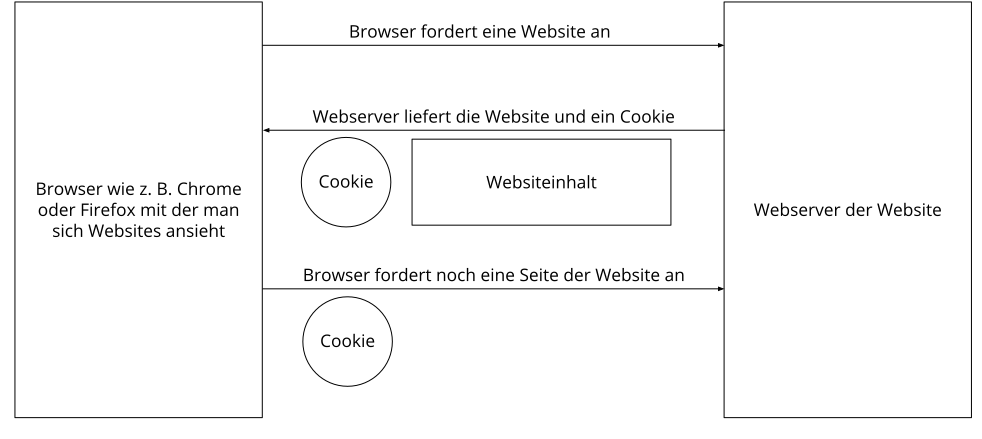
There are both first-party and third-party cookies. First-party cookies are created directly by our website, while third-party cookies are created by partner websites (e.g., Google Analytics). Each cookie must be evaluated individually, as each cookie stores different data. The expiration time of a cookie also varies from a few minutes to several years. Cookies are not software programs and do not contain viruses, Trojans, or other malware. Cookies cannot access information on your computer.
This is what cookie data might look like, for example:
Name: _ga
Value: GA1.2.1326744211.152112059781-9
Purpose of use: differentiation of website visitors
Expiration date: after 2 years
These are the minimum sizes a browser should be able to support:
- At least 4096 bytes per cookie
- At least 50 cookies per domain
- At least 3000 cookies in total
What types of cookies are there?
The specific cookies we use depend on the services used and are explained in the following sections of the privacy policy. At this point, we would like to briefly discuss the different types of HTTP cookies.
There are four types of cookies:
Essential Cookies
These cookies are necessary to ensure basic functions of the website. For example, these cookies are needed when a user puts a product in the shopping cart, then continues browsing on other pages and only later proceeds to checkout. These cookies do not delete the shopping cart, even if the user closes their browser window.
Purposeful cookies
These cookies collect information about user behavior and whether the user receives any error messages. In addition, these cookies are also used to measure the loading time and behavior of the website in different browsers.
Targeted cookies
These cookies improve user experience. For example, entered locations, font sizes or form data are saved.
advertising cookies
These cookies are also called targeting cookies. They are used to deliver individually tailored advertising to the user. This can be very convenient, but also very annoying.
Typically, when you first visit a website, you will be asked which types of cookies you wish to allow. And of course, this decision is also stored in a cookie.
If you would like to know more about cookies and are not afraid of technical documentation, we recommend https://datatracker.ietf.org/doc/html/rfc6265, the Request for Comments from the Internet Engineering Task Force (IETF) called “HTTP State Management Mechanism”.
Purpose of processing via cookies
The purpose ultimately depends on the cookie in question. You can find more details below or from the manufacturer of the software that sets the cookie.
Which data is processed?
Cookies are small tools that help with many different tasks. Unfortunately, it's impossible to generalize about what data is stored in cookies, but we will inform you about the data processed and stored in the following privacy policy.
storage period of cookies
The storage duration depends on the specific cookie and is further specified below. Some cookies are deleted after less than an hour, while others can remain stored on a computer for several years.
You also have control over the storage duration. You can manually delete all cookies at any time via your browser (see also “Right to object” below). Furthermore, cookies based on consent will be deleted at the latest after you withdraw your consent, whereby the lawfulness of the storage remains unaffected until then.
Right to object – how can I delete cookies?
You decide how and whether you want to use cookies. Regardless of the service or website the cookies originate from, you always have the option to delete, disable, or partially allow cookies. For example, you can block third-party cookies but allow all others.
If you want to see which cookies have been stored in your browser, or if you want to change or delete cookie settings, you can find this information in your browser settings:
Chrome: Delete, enable and manage cookies in Chrome
Safari: Managing cookies and website data with Safari
Firefox: Clear cookies to remove data that websites have stored on your computer
Internet Explorer: Deleting and managing cookies
Microsoft Edge: Delete and manage cookies
If you generally don't want to allow cookies, you can configure your browser to always notify you when a cookie is about to be set. This allows you to decide whether to allow each individual cookie. The procedure varies depending on the browser. The best way to find instructions is to search on Google using the keywords "delete cookies Chrome" or "disable cookies Chrome" if you are using the Chrome browser.
legal basis
The so-called “Cookie Guidelines” have been in place since 2009. They state that storing cookies is a consent (Article 6(1)(a) GDPR) requires your consent. However, reactions to these guidelines vary considerably across EU countries. In Austria, this directive was implemented in Section 165(3) of the Telecommunications Act (2021). In Germany, the cookie guidelines were not transposed into national law. Instead, they were largely implemented in Section 15(3) of the Telemedia Act (TMG), which was replaced by the Digital Services Act (DDG) in May 2024.
Strictly necessary cookies exist, even where no consent has been given. legitimate interests (Article 6 paragraph 1 letter f GDPR), which in most cases are of an economic nature. We want to provide visitors to the website with a pleasant user experience, and certain cookies are often absolutely necessary for this.
Unless strictly necessary, cookies are only used with your consent. The legal basis for this is Article 6(1)(a) GDPR.
The following sections will provide you with more detailed information about the use of cookies, if the software used employs cookies.
Webhosting Introduction
|
Webhosting Summary
👥 Affected: Visitors to the website 🤝 Purpose: professional website hosting and operational security 📓 Data processed: IP address, time of website visit, browser used, and other data. More details can be found below or on the website of your web hosting provider. 📅 Storage duration: depends on the respective provider, but usually 2 weeks ⚖️ Legal basis: Art. 6 para. 1 lit. f GDPR (Legitimate interests) |
What is web hosting?
When you visit websites these days, certain information – including personal data – is automatically generated and stored, and this website is no exception. This data should be processed as sparingly as possible and only with justification. By "website," we mean all web pages on a domain, i.e., everything from the homepage to the very last subpage (like this one). By "domain," we mean, for example, example.de or sample.com.
If you want to view a website on a computer, tablet, or smartphone, you use a program called a web browser. You're probably familiar with some web browsers by name: Google Chrome, Microsoft Edge, Mozilla Firefox, and Apple Safari. We simply call them browsers or web browsers.
To display the website, the browser needs to connect to another computer where the website's code is stored: the web server. Operating a web server is a complex and resource-intensive task, which is why it's usually handled by professional providers. These providers offer web hosting and ensure the reliable and error-free storage of website data. A lot of technical terms, but please bear with us, it gets better!
When your browser connects to the web server (desktop, laptop, tablet, or smartphone) and during data transmission to and from the web server, personal data may be processed. On the one hand, your computer stores data; on the other hand, the web server also needs to store data for a certain period of time to ensure proper operation.
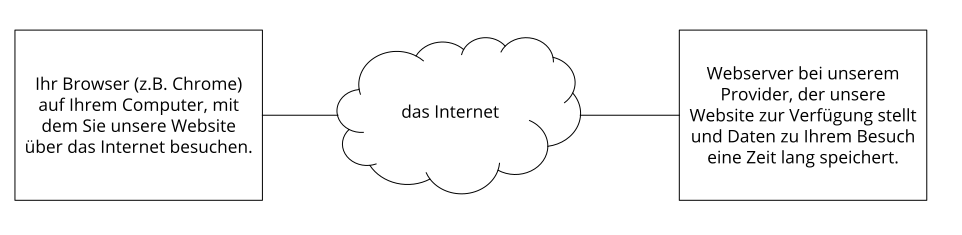
A picture is worth a thousand words, therefore the following graphic illustrates the interaction between browser, the internet and the hosting provider.
Why do we process personal data?
The purposes of data processing are:
- Professional hosting of the website and security of the operation
- to maintain operational and IT security
- Anonymous evaluation of access behavior to improve our offer and, if necessary, for criminal prosecution or the pursuit of claims
Which data is processed?
Even while you are currently visiting our website, our web server, which is the computer on which this website is stored, usually automatically stores data such as
- the complete Internet address (URL) of the website accessed
- Browser and browser version (e.g. Chrome 87)
- the operating system used (e.g. Windows 10)
- the address (URL) of the previously visited page (referrer URL) (e.g. https://www.beispielquellsite.de/vondabinichgekommen/)
- the hostname and IP address of the device from which access is made (e.g. COMPUTERNAME and 194.23.43.121)
- date and time
- in files, the so-called web server log files
How long is data stored?
As a rule, the above data is stored for two weeks and then automatically deleted. We do not pass this data on, but cannot rule out that this data will be viewed by authorities in the event of illegal behavior.
In short: Your visit is logged by our provider (company that runs our website on special computers (servers)), but we do not pass on your data without your consent!
legal basis
The lawfulness of processing personal data in the context of web hosting is based on Art. 6 para. 1 lit. f GDPR (safeguarding legitimate interests), because the use of professional hosting from a provider is necessary to present the company securely and user-friendly on the internet and to be able to pursue attacks and claims arising therefrom.
We and the hosting provider usually have a data processing agreement in accordance with Art. 28 f. GDPR, which ensures compliance with data protection and guarantees data security.
Website Modular Systems Introduction
|
Website Modular Systems Privacy Policy Summary
👥 Affected: Visitors to the website 🤝 Purpose: To optimize our service performance 📓 Data processed: Data such as technical usage information like browser activity, clickstream activity, session heatmaps, as well as contact details, IP address, or your geographic location. More details can be found below in this privacy policy and in the providers' privacy policies. 📅 Storage duration: depends on the provider ⚖️ Legal basis: Art. 6 para. 1 lit. f GDPR (Legitimate interests), Art. 6 para. 1 lit. a GDPR (Consent) |
What are website builder systems?
We use a website modular system for our website. Modular systems are special forms of a content management system (CMS). With a modular system, website operators can create a website very easily and without any programming knowledge. In many cases, web hosts also offer modular systems. By using a modular system, personal data can also be collected, stored and processed. In this data protection text, we give you general information about data processing by modular systems. You can find more information in the provider's data protection declarations.
Why do we use website builders for our website?
The biggest advantage of a modular website system is its ease of use. We want to offer you a clear, simple, and user-friendly website that we can easily operate and maintain ourselves – without external support. Modular systems now offer many helpful features that we can use even without programming knowledge. This allows us to design our web presence according to our wishes and provide you with an informative and enjoyable experience on our website.
What data is stored by a modular system?
Which data is stored depends, of course, on the website construction kit system used. Each provider processes and collects different data from website visitors. However, technical usage information such as operating system, browser, screen resolution, language and keyboard settings, hosting provider and the date of your website visit are usually collected. Tracking data (e.g. browser activity, clickstream activities, session heatmaps, etc.) can also be processed. Personal data can also be collected and stored. This usually includes contact data such as email address, telephone number (if you have provided this), IP address and geographical location data. You can find out exactly which data is stored in the provider's privacy policy.
How long and where is the data stored?
We will inform you about the duration of data processing below in connection with the website modular system used, provided we have further information about it. You can find detailed information about this in the provider's privacy policy. In general, we only process personal data for as long as it is absolutely necessary to provide our services and products. It is possible that the provider stores your data according to its own specifications, over which we have no influence.
right of objection
You always have the right to access, correct, and delete your personal data. If you have any questions, you can also contact the responsible party for the website builder system at any time. Contact details can be found either in our privacy policy or on the website of the respective provider.
You can delete, disable, or manage cookies used by providers for their functions in your browser. The process varies depending on the browser you use. Please note, however, that some functions may no longer work as expected.
legal basis
We have a legitimate interest in using a website builder to optimize our online service and present it to you efficiently and in a user-friendly manner. The corresponding legal basis for this is Article 6(1)(f) GDPR (legitimate interests). However, we only use the website builder if you have given your consent.
Insofar as the processing of data is not strictly necessary for the operation of the website, data will only be processed based on your consent. This applies in particular to tracking activities. The legal basis for this is Article 6(1)(a) GDPR.
This privacy policy provides you with the most important general information about data processing. If you would like more detailed information, you can find further details – if available – in the following section or in the provider's privacy policy.
WordPress.com Privacy Policy
|
WordPress.com Privacy Policy Summary
👥 Affected: Visitors to the website 🤝 Purpose: To optimize our service performance 📓 Data processed: Data such as technical usage information like browser activity, clickstream activity, session heatmaps, as well as contact details, IP address, or your geographic location. More details can be found below in this privacy policy. 📅 Storage duration: It depends primarily on the type of data being stored and the specific settings. ⚖️ Legal basis: Art. 6 para. 1 lit. a GDPR (consent), Art. 6 para. 1 lit. f GDPR (legitimate interests) |
What is WordPress?
We use the well-known content management system WordPress.com for our website. The service provider is the American company Automattic Inc., 60 29th Street #343, San Francisco, CA 94110, USA.
Founded in 2003, the company quickly became one of the world's most renowned content management systems (CMS). A CMS is software that helps us design our website and present content attractively and in an organized manner. This content can include text, audio, and video.
Using WordPress may result in the collection, storage, and processing of your personal data. Typically, this primarily involves technical data such as operating system, browser, screen resolution, and hosting provider. However, personal data such as IP address, geographic location, and contact information may also be processed.
Why do we use WordPress on our website?
We have many strengths, but actual programming is simply not one of our core competencies.
Nevertheless, we want a high-performing and attractive website that we can manage and maintain ourselves. A website builder or content management system like WordPress makes this possible. With WordPress, we don't need to be programming experts to offer you a beautiful website. Thanks to WordPress, we can operate our website quickly and easily, even without prior technical knowledge. If technical problems arise or we have specific requirements for our website, we always have our specialists who are proficient in HTML, PHP, CSS, and other related technologies.
Thanks to WordPress's ease of use and comprehensive functions, we can design our website according to our wishes and offer you a good user experience.
What data does WordPress process?
Non-personal data includes technical usage information such as browser activity, clickstream activity, session heatmaps and data about your computer, operating system, browser, screen resolution, language and keyboard settings, internet provider and date of page visit.
In addition, personal data is also collected. This primarily includes contact information (email address or telephone number, if you provide it), IP address, or your geographical location.
WordPress can also use cookies to collect data. This often includes information about your behavior on our website. For example, it can track which subpages you particularly like to visit, how long you stay on individual pages, when you leave a page (bounce rate), and your preferences (e.g., language selection). Based on this data, WordPress can better tailor its marketing efforts to your interests and user behavior. Consequently, the next time you visit our website, it will be displayed according to your previous settings.
WordPress can also use technologies such as pixel tags (web beacons) to, for example, clearly identify you as a user and potentially offer interest-based advertising.
How long and where is the data stored?
How long data is stored depends on various factors. It primarily depends on the type of data stored and the specific website settings. Generally, WordPress deletes data when it is no longer needed for its own purposes. There are, of course, exceptions, especially when legal obligations require longer data retention. Web server logs, which contain your IP address and technical data, are deleted by WordPress and Automattic after 30 days. Automattic uses this data to analyze traffic on its own websites (for example, all WordPress pages) and to troubleshoot potential problems. Deleted content on WordPress websites is also kept in the trash for 30 days to allow for restoration; after that, it may remain in backups and caches until they are deleted. The data is stored on Automattic's servers in the USA.
How can I delete my data or prevent data storage?
You have the right and the ability to access your personal data at any time and to object to its use and processing. You can also lodge a complaint with a government supervisory authority at any time.
Your browser also allows you to manage, delete, or disable cookies individually. However, please note that disabling or deleting cookies may negatively impact the functionality of our WordPress site. Managing cookies varies slightly depending on the browser you use. You'll find links to instructions for the most common browsers in the "Cookies" section.
legal basis
If you have consented to the use of WordPress, the legal basis for the corresponding data processing is this consent. According to Article 6(1)(a) GDPR (consent), this consent constitutes the legal basis for the processing of personal data, such as that which may occur during collection by WordPress.
We also have a legitimate interest in using WordPress to optimize our online service and present it attractively to you. The legal basis for this is Article 6(1)(f) GDPR (legitimate interests). However, we only use WordPress if you have given your consent.
WordPress, or rather Automattic, processes your data in the USA, among other locations. Automattic is an active participant in the EU-US Data Privacy Framework, which regulates the correct and secure transfer of personal data of EU citizens to the USA. You can find more information about this at [link to relevant information]. https://commission.europa.eu/document/fa09cbad-dd7d-4684-ae60-be03fcb0fddf_en.
Furthermore, Automattic uses so-called Standard Contractual Clauses (Article 46, paragraphs 2 and 3 of the GDPR). Standard Contractual Clauses (SCCs) are template agreements provided by the European Commission and are designed to ensure that your data complies with European data protection standards even when it is transferred to and stored in third countries (such as the USA). Through the EU-US Data Privacy Framework and the Standard Contractual Clauses, Automattic commits to maintaining European data protection standards when processing your relevant data, even if the data is stored, processed, and managed in the USA. These clauses are based on an implementing decision of the European Commission. You can find the decision and the corresponding Standard Contractual Clauses here, among other places: https://eur-lex.europa.eu/eli/dec_impl/2021/914/oj?locale=de
More details about the privacy policy and what data is processed by WordPress and how can be found on [website address]. https://automattic.com/privacy/.
Data Processing Agreement (AVV) WordPress.com
In accordance with Article 28 of the General Data Protection Regulation (GDPR), we have concluded a data processing agreement (DPA) with WordPress.com. You can find out exactly what a DPA is and, above all, what it must contain in our general section "Data Processing Agreement (DPA).".
This agreement is legally required because WordPress.com processes personal data on our behalf. It stipulates that WordPress.com may only process data received from us according to our instructions and must comply with the GDPR. You can find the link to the data processing agreement (DPA) at [link to DPA]. https://wordpress.com/support/data-processing-agreements/.
Web Analytics Introduction
|
Web Analytics Privacy Policy Summary
👥 Affected: Visitors to the website 🤝 Purpose: Evaluation of visitor information to optimize the website. 📓 Data processed: Access statistics, including data such as access locations, device data, access duration and time, navigation behavior, click behavior, and IP addresses. More details can be found in the documentation for the respective web analytics tool used. 📅 Storage duration: depends on the web analytics tool used ⚖️ Legal basis: Art. 6 para. 1 lit. a GDPR (consent), Art. 6 para. 1 lit. f GDPR (legitimate interests) |
What is Web Analytics?
We use software on our website to evaluate the behavior of website visitors, known as web analytics or web analysis for short. This collects data that the respective analytics tool provider (also known as tracking tool) stores, manages and processes. The data is used to create analyses of user behavior on our website and makes it available to us as website operators. In addition, most tools offer various testing options. For example, we can test which offers or content are most popular with our visitors. To do this, we show you two different offers for a limited period of time. After the test (so-called A/B test), we know which product or content our website visitors find more interesting. For such testing procedures, as for other analytics procedures, user profiles can also be created and the data stored in cookies.
Why do we use web analytics?
We have a clear goal in mind with our website: we want to provide the best web offering on the market for our industry. To achieve this goal, we want to offer the best and most interesting offering on the one hand and, on the other hand, make sure that you feel completely comfortable on our website. With the help of web analysis tools, we can take a closer look at the behavior of our website visitors and then improve our web offering for you and us accordingly. For example, we can see how old our visitors on average are, where they come from, when our website is visited most often or which content or products are particularly popular. All of this information helps us to optimize the website and thus adapt it as best as possible to your needs, interests and wishes.
Which data is processed?
Exactly which data is stored depends, of course, on the analytics tools used. However, it typically includes information such as which content you view on our website, which buttons or links you click, when you access a page, which browser you use, which device (PC, tablet, smartphone, etc.) you use to visit the website, and which computer system you are using. If you have consented to the collection of location data, this may also be processed by the web analytics tool provider.
Your IP address will also be stored. According to the General Data Protection Regulation (GDPR), IP addresses are considered personal data. However, your IP address is generally stored in pseudonymized form (i.e., in an unidentifiable and shortened form). For the purposes of testing, web analytics, and web optimization, no direct data such as your name, age, address, or email address is stored. All such data, if collected, is stored pseudonymously. This ensures that you cannot be identified as an individual.
The following example schematically illustrates how Google Analytics works as an example of client-based web tracking using JavaScript code.
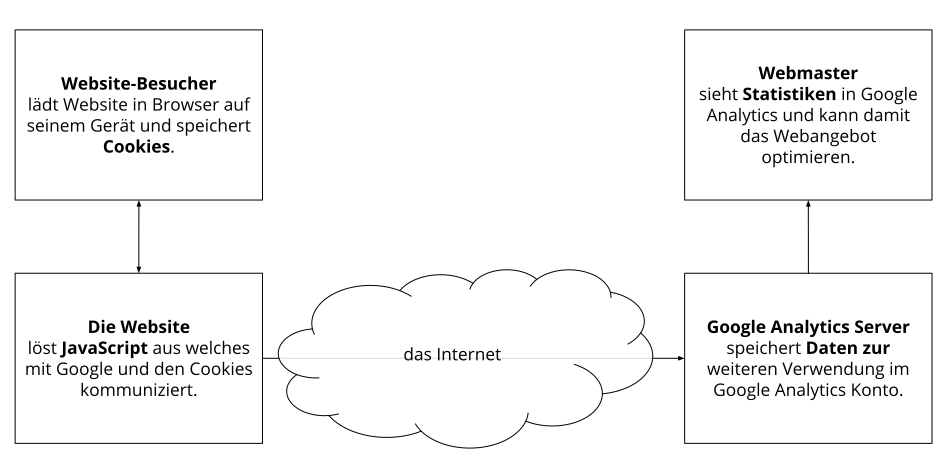
How long the respective data is stored always depends on the provider. Some cookies only store data for a few minutes or until you leave the website again, other cookies can store data for several years.
duration of data processing
We will inform you about the duration of data processing below, provided we have further information on this. In general, we only process personal data for as long as it is absolutely necessary to provide our services and products. If it is required by law, such as in the case of accounting, this storage period can also be exceeded.
right of objection
You also have the right and the option to revoke your consent to the use of cookies or third-party providers at any time. This works either via our cookie management tool or via other opt-out functions. For example, you can also prevent data collection through cookies by managing, deactivating or deleting cookies in your browser.
legal basis
The use of web analytics requires your consent, which we have obtained with our cookie popup. This consent is according to Art. 6 para. 1 lit. a GDPR (consent) This represents the legal basis for the processing of personal data, such as that which may occur when collected by web analytics tools.
In addition to consent, we have a legitimate interest in analyzing website visitor behavior to improve our services both technically and economically. Web analytics helps us identify website errors, detect attacks, and improve efficiency. The legal basis for this is... Art. 6 para. 1 lit. f GDPR (legitimate interests). However, we only use these tools if you have given your consent.
Since web analytics tools use cookies, we also recommend that you read our general privacy policy regarding cookies. To learn exactly which of your data is stored and processed, you should read the privacy policies of the respective tools.
Information on specific web analytics tools can be found – if available – in the following sections.
Google Analytics Privacy Policy
|
Google Analytics Privacy Policy Summary
👥 Affected: Visitors to the website 🤝 Purpose: Evaluation of visitor information to optimize the website. 📓 Data processed: Access statistics, including data such as access locations, device data, access duration and time, navigation behavior, and click behavior. More details can be found below in this privacy policy. 📅 Storage duration: individually adjustable; by default, Google Analytics stores 4 data points for 14 months. ⚖️ Legal basis: Art. 6 para. 1 lit. a GDPR (consent), Art. 6 para. 1 lit. f GDPR (legitimate interests) |
What is Google Analytics?
We use the Google Analytics tracking tool, version 4 (GA4), from the American company Google Inc. on our website. For the European region, Google Ireland Limited (Gordon House, Barrow Street, Dublin 4, Ireland) is responsible for all Google services. Google Analytics collects data about your activity on our website. By combining various technologies such as cookies, device IDs, and login information, you as a user can be identified across different devices. This allows your activity to be analyzed across platforms.
For example, when you click a link, this event is stored in a cookie and sent to Google Analytics. The reports we receive from Google Analytics help us to better tailor our website and services to your needs. Below, we explain the tracking tool in more detail, focusing on what data is processed and how you can prevent this.
Google Analytics is a tracking tool used to analyze website traffic. These measurements and analyses are based on a pseudonymous user identification number. This number does not contain any personal data such as name or address, but rather serves to assign events to a specific device. GA4 uses an event-based model that captures detailed information about user interactions such as page views, clicks, scrolling, and conversion events. Furthermore, GA4 incorporates various machine learning functions to better understand user behavior and certain trends. GA4 uses machine learning to generate models. This means that, based on the collected data, missing data can be extrapolated to optimize the analysis and enable forecasting.
For Google Analytics to function correctly, a tracking code is embedded in our website's code. When you visit our website, this code records various actions you perform on our site. Using GA4's event-driven data model, we, as website operators, can define and track specific events to analyze user interactions. This allows us to track not only general information like clicks and page views, but also specific events that are important to our business. These specific events might include submitting a contact form or purchasing a product.
As soon as you leave our website, this data will be sent to and stored on Google Analytics servers.
Google processes the data and we receive reports about your user behavior. These may include, among other things, the following reports:
- Target group reports: Through target group reports we get to know our users better and know more precisely who is interested in our service.
- Ad Reporting: Ad Reporting helps us analyze and improve our online advertising.
- Acquisition reports: Acquisition reports give us helpful information about how we can get more people excited about our service.
- Behavioral reports: This tells us how you interact with our website. We can see which path you take on our site and which links you click on.
- Conversion reports: A conversion is a process in which you perform a desired action based on a marketing message. For example, when you go from being a pure website visitor to becoming a buyer or newsletter subscriber. These reports help us learn more about how our marketing measures are received by you. This is how we want to increase our conversion rate.
- Real-time reports: Here we always know immediately what is happening on our website. For example, we can see how many users are currently reading this text.
In addition to the analysis reports mentioned above, Google Analytics 4 also offers the following functions:
- Event-based data model: This model records very specific events that can take place on our website. For example, playing a video, purchasing a product or signing up for our newsletter.
- Advanced analysis functions: These functions enable us to understand your behavior on our website or certain general trends even better. For example, we can segment user groups, carry out comparative analyses of target groups or track your route or path on our website.
- Predictive modeling: Using collected data, machine learning can extrapolate missing data that predicts future events and trends. This can help us develop better marketing strategies.
- Cross-platform analysis: Data can be collected and analyzed from both websites and apps. This gives us the opportunity to analyze user behavior across platforms, provided you have consented to data processing, of course.
Why do we use Google Analytics on our website?
Our goal with this website is clear: We want to offer you the best possible service. The statistics and data from Google Analytics help us achieve this goal.
The statistically analyzed data gives us a clear picture of our website's strengths and weaknesses. On the one hand, we can optimize our site so that it's easier for interested people to find it on Google. On the other hand, the data helps us understand you, our visitors, better. We therefore know exactly what we need to improve on our website to offer you the best possible service. The data also helps us to make our advertising and marketing efforts more targeted and cost-effective. After all, it only makes sense to show our products and services to people who are interested in them.
What data is stored by Google Analytics?
Google Analytics uses a tracking code to create a random, unique ID that is linked to your browser cookie. This allows Google Analytics to recognize you as a new user and assign you a user ID. The next time you visit our site, you will be recognized as a returning user. All collected data is stored along with this user ID. This is the only way to analyze pseudonymous user profiles.
To analyze our website with Google Analytics, a property ID must be inserted into the tracking code. The data is then stored in the corresponding property. The Google Analytics 4 property is the default for every newly created property. Data is stored for varying lengths of time depending on the property used.
Your interactions are measured across platforms using identifiers such as cookies, app instance IDs, user IDs, or custom event parameters, provided you have consented. Interactions are all types of actions you perform on our website. If you also use other Google systems (such as a Google account), data generated via Google Analytics may be linked to third-party cookies. Google does not share Google Analytics data unless we, as the website operator, authorize it. Exceptions may occur if required by law.
According to Google, Google Analytics 4 does not log or store IP addresses. However, Google uses IP address data to derive location data and deletes it immediately afterward. Therefore, all IP addresses collected from users in the EU are deleted before the data is stored in a data center or on a server.
Since Google Analytics 4 focuses on event-based data, the tool uses significantly fewer cookies compared to earlier versions (such as Google Universal Analytics). However, there are some specific cookies used by GA4. These include, for example:
Name: _ga
Value: 2.1326744211.152112059781-5
Purpose of use: By default, analytics.js uses the cookie _ga to store the user ID. Basically, it is used to distinguish between website visitors.
Expiration date: after 2 years
Name: _gid
Value: 2.1687193234.152112059781-1
Purpose of use: The cookie is also used to distinguish website visitors
Expiration date: after 24 hours
Name: _gat_gtag_UA_
Value: 1
Purpose of use: Used to reduce the request rate. If Google Analytics is provided via Google Tag Manager, this cookie is named _dc_gtm_ .
Expiration date: after 1 minute
Note: This list is not exhaustive, as Google frequently changes its cookie selection. GA4 also aims to improve data privacy. Therefore, the tool offers several options for controlling data collection. For example, we can define the storage duration ourselves and also control the data collection process.
Here we show you an overview of the most important types of data collected with Google Analytics:
Heatmaps: Google creates so-called heat maps. Heat maps show exactly the areas you click on. This gives us information about where you are on our site.
Session duration: Google defines the session duration as the time you spend on our site without leaving the site. If you have been inactive for 20 minutes, the session ends automatically.
bounce rate Bounce rate: A bounce occurs when you only view one page on our website and then leave our website again.
Account creation: When you create an account or place an order on our website, Google Analytics collects this data.
Location: IP addresses are not logged or stored in Google Analytics. However, derivations for location data are used shortly before the IP address is deleted.
Technical information: Technical information includes your browser type, your Internet provider or your screen resolution.
Source: Google Analytics, or rather we, are of course also interested in which website or advertisement you came to our site via.
Other data collected includes contact information, any ratings, media playback (e.g., when you play a video on our site), sharing content via social media, or adding items to your favorites. This list is not exhaustive and serves only as a general guide to data storage by Google Analytics.
How long and where is the data stored?
Google has its servers distributed all over the world. Here you can find out exactly where the Google data centers are located: https://datacenters.google/
Your data is distributed across various physical storage devices. This has the advantage of faster data retrieval and better protection against manipulation. Each Google data center has corresponding emergency backup programs for your data. Even if, for example, Google's hardware fails or natural disasters disable servers, the risk of a service interruption at Google remains low.
The data retention period depends on the properties used. The storage duration is always set individually for each property. Google Analytics offers four options for controlling the storage duration:
- 2 months: this is the shortest storage period.
- 14 months: by default, data is stored in GA4 for 14 months.
- 26 months: you can also store the data for 26 months.
- Data will only be deleted when we delete it manually
Additionally, there is the option to have data deleted only if you do not visit our website within the period we have selected. In this case, the retention period will be reset each time you visit our website again within the specified period.
Once the specified period has expired, the data is deleted once a month. This retention period applies to your data that is linked to cookies, user recognition, and advertising IDs (e.g., cookies from the DoubleClick domain). Report results are based on aggregated data and are stored separately from user data. Aggregated data is a combination of individual data points into a larger unit.
How can I delete my data or prevent data storage?
Under European Union data protection law, you have the right to obtain information about your data, to update it, to delete it or to restrict it. You can use the browser add-on to deactivate Google Analytics JavaScript (analytics.js, gtag.js) to prevent Google Analytics 4 from using your data. You can download the browser add-on at https://tools.google.com/dlpage/gaoptout?hl=de Download and install. Please note that this add-on only disables data collection by Google Analytics.
If you wish to disable, delete or manage cookies in general, you will find the corresponding links to the respective instructions for the most well-known browsers under the section "Cookies".
legal basis
The use of Google Analytics requires your consent, which we have obtained with our cookie popup. This consent is provided according to Art. 6 para. 1 lit. a GDPR (consent) This represents the legal basis for the processing of personal data, such as that which may occur when collected by web analytics tools.
In addition to consent, we have a legitimate interest in analyzing website visitor behavior to improve our services both technically and economically. Google Analytics helps us identify website errors, detect attacks, and improve efficiency. The legal basis for this is... Art. 6 para. 1 lit. f GDPR (legitimate interests). We only use Google Analytics if you have given your consent.
Google processes your data, among other places, in the USA. Google is an active participant in the EU-US Data Privacy Framework, which regulates the correct and secure transfer of personal data of EU citizens to the USA. You can find more information about this at [link to Google's privacy policy]. https://commission.europa.eu/document/fa09cbad-dd7d-4684-ae60-be03fcb0fddf_en.
Furthermore, Google uses so-called Standard Contractual Clauses (Article 46, paragraphs 2 and 3 of the GDPR). Standard Contractual Clauses (SCCs) are template agreements provided by the European Commission and are designed to ensure that your data complies with European data protection standards even when it is transferred to and stored in third countries (such as the USA). Through the EU-US Data Privacy Framework and the Standard Contractual Clauses, Google commits to maintaining European data protection standards when processing your relevant data, even if the data is stored, processed, and managed in the USA. These clauses are based on an implementing decision of the European Commission. You can find the decision and the corresponding Standard Contractual Clauses here, among other places: https://eur-lex.europa.eu/eli/dec_impl/2021/914/oj?locale=de
The Google Ads Data Processing Terms, which refer to the standard contractual clauses, can be found at https://business.safety.google/intl/de/adsprocessorterms/.
We hope we have provided you with the most important information regarding data processing by Google Analytics. If you would like to learn more about the tracking service, we recommend these two links: https://marketingplatform.google.com/about/analytics/terms/de/ and https://support.google.com/analytics/answer/6004245?hl=de.
If you would like to learn more about data processing, please refer to the Google Privacy Policy at https://policies.google.com/privacy?hl=de.
Data Processing Agreement (AVV) Google Analytics
In accordance with Article 28 of the General Data Protection Regulation (GDPR), we have concluded a data processing agreement (DPA) with Google. You can find out exactly what a DPA is and, above all, what it must contain in our general section "Data Processing Agreement (DPA).".
This agreement is legally required because Google processes personal data on our behalf. It stipulates that Google may only process data received from us according to our instructions and must comply with the GDPR. You can find the link to the data processing agreement here. https://business.safety.google/intl/de/adsprocessorterms/
Google Analytics reports on demographics and interests
We have enabled advertising reporting features in Google Analytics. The demographic and interest reports provide information about age, gender, and interests. This allows us to gain a better understanding of our users without being able to attribute this data to individual persons. You can learn more about advertising features at [link to Google Analytics website]. https://support.google.com/analytics/answer/3450482?hl=de_AT&utm_id=ad.
You can control the use of your Google account activity and information under “Ad settings”. https://adssettings.google.com/authenticated End via checkbox.
Google Analytics in consent mode
Depending on your consent, your personal data will be processed by Google Analytics in the so-called consent mode. You can choose whether or not you agree to Google Analytics cookies. This also means that you choose which data Google Analytics may process from you. This data collected is mainly used to carry out measurements of user behavior on the website, display targeted advertising, and provide us with web analysis reports. As a rule, you consent to data processing by Google using a cookie consent tool. If you do not consent to data processing, only aggregated data will be collected and processed. This means that data cannot be assigned to individual users and no user profile is created of you. You can also only consent to statistical measurement. No personal data will be processed and therefore not used for advertisements or advertising measurement results.
Google Analytics IP anonymization
We have implemented IP address anonymization for Google Analytics on this website. This feature was developed by Google to ensure that this website complies with applicable data protection regulations and the recommendations of local data protection authorities, particularly where the storage of complete IP addresses is prohibited. The anonymization or masking of the IP address takes place as soon as the IP addresses arrive in the Google Analytics data collection network and before any data is stored or processed.
More information about IP anonymization can be found at https://support.google.com/analytics/answer/2763052?hl=de.
Google Optimize Privacy Policy
We use Google Optimize, a website optimization tool, on our website. The service provider is the American company Google Inc. For the European region, Google Ireland Limited (Gordon House, Barrow Street, Dublin 4, Ireland) is responsible for all Google services.
Google processes your data, among other places, in the USA. Google is an active participant in the EU-US Data Privacy Framework, which regulates the correct and secure transfer of personal data of EU citizens to the USA. You can find more information about this at [link to Google's privacy policy]. https://commission.europa.eu/document/fa09cbad-dd7d-4684-ae60-be03fcb0fddf_en.
Furthermore, Google uses so-called Standard Contractual Clauses (Article 46, paragraphs 2 and 3 of the GDPR). Standard Contractual Clauses (SCCs) are template agreements provided by the European Commission and are designed to ensure that your data complies with European data protection standards even when it is transferred to and stored in third countries (such as the USA). Through the EU-US Data Privacy Framework and the Standard Contractual Clauses, Google commits to maintaining European data protection standards when processing your relevant data, even if the data is stored, processed, and managed in the USA. These clauses are based on an implementing decision of the European Commission. You can find the decision and the corresponding Standard Contractual Clauses here, among other places: https://eur-lex.europa.eu/eli/dec_impl/2021/914/oj?locale=de
The Google Ads Data Processing Terms, which refer to the standard contractual clauses, can be found at https://business.safety.google/intl/de/adsprocessorterms/.
You can find out more about the data processed through the use of Google Optimize in the Privacy Policy at [link to Privacy Policy]. https://policies.google.com/privacy?hl=de.
Data Processing Agreement (AVV) Google Optimize
In accordance with Article 28 of the General Data Protection Regulation (GDPR), we have concluded a data processing agreement (DPA) with Google. You can find out exactly what a DPA is and, above all, what it must contain in our general section "Data Processing Agreement (DPA).".
This agreement is legally required because Google processes personal data on our behalf. It stipulates that Google may only process data received from us according to our instructions and must comply with the GDPR. You can find the link to the data processing agreement here. https://business.safety.google/intl/de/adsprocessorterms/
Google Site Kit Privacy Policy
|
Google Site Kit Privacy Policy Summary
👥 Affected: Visitors to the website 🤝 Purpose: Evaluation of visitor information to optimize the website. 📓 Data processed: Access statistics, including data such as access locations, device data, access duration and time, navigation behavior, click behavior, and IP addresses. More details can be found below and in the Google Analytics privacy policy. 📅 Storage duration: depends on the properties used ⚖️ Legal basis: Art. 6 para. 1 lit. a GDPR (consent), Art. 6 para. 1 lit. f GDPR (legitimate interests) |
What is Google Site Kit?
We have integrated the WordPress plugin Google Site Kit from the American company Google Inc. into our website. For the European region, Google Ireland Limited (Gordon House, Barrow Street, Dublin 4, Ireland) is responsible for all Google services. Google Site Kit allows us to quickly and easily view statistics from various Google products, such as Google Analytics, directly in our WordPress dashboard. This tool, or rather the tools integrated into Google Site Kit, also collect your personal data. In this privacy policy, we explain why we use Google Site Kit, how long and where data is stored, and what other data protection information is relevant to you in this context.
Google Site Kit is a plugin for the WordPress content management system. With this plugin, we can view important website analytics statistics directly in our dashboard. These statistics are collected by other Google products, primarily Google Analytics. In addition to Google Analytics, Google Site Kit can also be integrated with Google Search Console, PageSpeed Insights, Google AdSense, Google Optimize, and Google Tag Manager.
Why do we use Google Site Kit on our website?
As a service provider, it is our job to offer you the best possible experience on our website. You should feel comfortable on our website and quickly and easily find exactly what you are looking for. Statistical evaluations help us to get to know you better and to adapt our offer to your wishes and interests. We use various Google tools for these evaluations. Site Kit makes our work much easier in this regard because we can view and analyze the statistics of Google products directly in the dashboard. This means we no longer have to register separately for the respective tool. Site Kit therefore always offers a good overview of the most important analysis data.
What data does Google Site Kit store?
If you have actively consented to tracking tools in the cookie notice (also called script or banner), Google products such as Google Analytics will set cookies and send data about you, such as your user behavior, to Google, where it is stored and processed. This includes personal data such as your IP address.
For more detailed information about each service, we have dedicated sections within this privacy policy. For example, please see our privacy policy for Google Analytics. Here, we discuss the data collected in detail. You will learn how long Google Analytics stores, manages, and processes data, which cookies may be used, and how you can prevent data storage. We also have separate privacy policies with comprehensive information for other Google services, such as Google Tag Manager and Google AdSense.
Below, we show you examples of Google Analytics cookies that may be set in your browser, provided you have generally consented to data processing by Google. Please note that this is only a selection of cookies:
Name: _ga
Value:2.1326744211.152112059781-2
Purpose of use: By default, analytics.js uses the cookie _ga to store the user ID. Basically, it is used to distinguish between website visitors.
Expiration date: after 2 years
Name: _gid
Value:2.1687193234.152112059781-7
Purpose of use: This cookie is also used to distinguish website visitors.
Expiration date: after 24 hours
Name: _gat_gtag_UA_
Value: 1
Purpose of use: This cookie is used to reduce the request rate.
Expiration date: after 1 minute
How long and where is the data stored?
Google stores collected data on its own Google servers, which are located worldwide. Most servers are located in the United States and therefore it is quite possible that your data will also be stored there. On https://datacenters.google/ See exactly where the company provides servers.
Data collected through Google Analytics is stored for a standard period of 26 months. After this time, your user data is deleted. This retention period applies to all data associated with cookies, user recognition, and advertising IDs.
How can I delete my data or prevent data storage?
You always have the right to access, delete, correct, or restrict your data. Furthermore, you can disable, delete, or manage cookies in your browser at any time.
If you wish to disable, delete or manage cookies in general, you will find the corresponding links to the respective instructions for the most well-known browsers under the section "Cookies".
legal basis
The use of Google Site Kit requires your consent, which we have obtained with our cookie popup. This consent is according to Art. 6 para. 1 lit. a GDPR (consent) This represents the legal basis for the processing of personal data, such as that which may occur when collected by web analytics tools.
In addition to consent, we have a legitimate interest in analyzing website visitor behavior to improve our services both technically and economically. Using Google Site Kit, we can identify website errors, detect attacks, and improve efficiency. The legal basis for this is... Art. 6 para. 1 lit. f GDPR (legitimate interests). We only use Google Site Kit if you have given your consent.
Google processes your data, among other places, in the USA. Google is an active participant in the EU-US Data Privacy Framework, which regulates the correct and secure transfer of personal data of EU citizens to the USA. You can find more information about this at [link to Google's privacy policy]. https://commission.europa.eu/document/fa09cbad-dd7d-4684-ae60-be03fcb0fddf_en.
Furthermore, Google uses so-called Standard Contractual Clauses (Article 46, paragraphs 2 and 3 of the GDPR). Standard Contractual Clauses (SCCs) are template agreements provided by the European Commission and are designed to ensure that your data complies with European data protection standards even when it is transferred to and stored in third countries (such as the USA). Through the EU-US Data Privacy Framework and the Standard Contractual Clauses, Google commits to maintaining European data protection standards when processing your relevant data, even if the data is stored, processed, and managed in the USA. These clauses are based on an implementing decision of the European Commission. You can find the decision and the corresponding Standard Contractual Clauses here, among other places: https://eur-lex.europa.eu/eli/dec_impl/2021/914/oj?locale=de
The Google Ads Data Processing Terms, which refer to the standard contractual clauses, can be found at https://business.safety.google/intl/de/adsprocessorterms/.
To learn more about data processing by Google, we recommend that you read Google's comprehensive privacy policy at [link to Google's privacy policy]. https://policies.google.com/privacy?hl=de.
Chatbots Introduction
|
Chatbot Privacy Policy Summary
👥 Affected: Visitors to the website 🤝 Purpose: Contact requests and general communication between us and you 📓 Data processed: Data such as name, address, email address, telephone number, general content data, and, if applicable, IP address. More details can be found in the descriptions of the respective tools used. 📅 Storage duration: depends on the chatbots and chat functions used. ⚖️ Legal basis: Art. 6 para. 1 lit. a GDPR (consent), Art. 6 para. 1 lit. f GDPR (legitimate interests), Art. 6 para. 1 sentence 1 lit. b GDPR (contractual or pre-contractual obligations) |
What are chatbots?
You can also communicate with us via chatbots or similar chat functions. A chat offers the possibility of writing or speaking to each other with very little delay. A chatbot is software that attempts to answer your question and may inform you about news. By using these communication methods, your personal data may also be processed and stored.
Why do we use chatbots?
Communication with you is important to us. We want to talk to you and answer all your questions about our service as best we can. Effective communication is a key part of what we do. Chatbots offer the significant advantage of allowing us to automatically answer frequently asked questions. This saves us time, while still providing you with comprehensive and helpful answers. Of course, if the chatbot can't help, you can always contact us directly.
Please note that when using our built-in elements, your data may also be processed outside the European Union, as many providers are American companies. This may make it more difficult for you to assert or enforce your rights regarding your personal data.
Which data is processed?
It's possible that you might use the chat services on other websites/platforms as well. In this case, your user ID will also be stored on the servers of this website. We may also be informed which user used the chat and when. The content of the conversations will also be stored. The exact data stored depends on the specific service. However, it generally includes contact information such as email address or phone number, IP address, and various usage data.
If you have consented to the use of the chat function, this consent, along with any registration, will also be stored and logged. We do this so that we can provide proof of registration or consent if legally required.
The provider of a chat platform can also know when you are chatting and receives technical information about the device you are using. Exactly which information is stored and processed depends on your computer settings. In many cases, data about your approximate location may be collected. This is done, on the one hand, to optimize the chat services and, on the other hand, to ensure greater security. Furthermore, the information can also be used to implement personalized advertising and marketing measures.
If you have consented to receive messages from a chatbot, you can, of course, deactivate this feature at any time. The chatbot will guide you through the process and show you how to unsubscribe. All your related data will then be deleted from the recipient list.
We use the data mentioned above to, for example, address you personally via chat, answer your questions and inquiries, or send you relevant content. This also allows us to improve our chat services in general.
How long is data stored?
How long data is processed and stored depends primarily on the tools we use. You can find more information about the data processing practices of each tool below. The providers' privacy policies typically specify exactly which data is stored and processed, and for how long. Generally, personal data is only processed for as long as necessary to provide our services. When data is stored in cookies, the storage duration varies considerably. The data may be deleted immediately after leaving a website, or it may remain stored for several years. Therefore, you should examine each individual cookie in detail if you want to know more about data storage. You will usually find informative details about the individual cookies in the privacy policies of the respective providers.
right of objection
You also have the right and the option to revoke your consent to the use of cookies or third-party providers at any time. This works either via our cookie management tool or via other opt-out functions. For example, you can also prevent data collection through cookies by managing, deactivating or deleting cookies in your browser.
Since chat services may use cookies, we also recommend that you read our general privacy policy on cookies. To find out exactly what data is stored and processed about you, you should read the privacy policies of the respective tools.
legal basis
We will ask for your permission via a pop-up window to process your data within the context of our chat services. If you consent, this consent also serves as the legal basis for processing your data. (Art. 6 para. 1 lit. a GDPR) for data processing. Furthermore, we process your inquiries and manage your data within the framework of contractual or pre-contractual relationships in order to fulfill our pre-contractual and contractual obligations and/or to answer inquiries. The legal basis for this is... Article 6 paragraph 1 sentence 1 letter b. GDPRIn principle, your data will also be processed on the basis of our legitimate interest (Art. 6 para. 1 lit. f GDPR) Your data is stored and processed to enable fast and effective communication with you, other customers, and business partners. However, we only use these tools if you have given your consent.
Live chat with Crisp
A notice: The following section „Live chat with Crisp“ is an addition by the website operator and is not part of the sample privacy policy provided by AdSimple.
Type and purpose of processing: We use the Crisp live chat service on our website. You can ask us questions via chat; our customer service team will answer your inquiries. The chat will only load after you have given your consent in the cookie banner.
Provider: Crisp IM SAS, 2 Boulevard de Launay, 44100 Nantes, France.
Data processed: When loading the chat, Crisp processes technical data such as your IP address. If you write to us in the chat, we also process your messages and the information you provide yourself (e.g., name, email address, or sent files).
Cookies and storage duration: Crisp stores cookies with the prefix "crisp-client" to maintain your chat session. These cookies expire after approximately six months.
Legal basis: We only load Crisp with your consent. The legal basis for this is therefore Article 6(1)(a) GDPR. You can withdraw your consent at any time via the "Privacy Preferences" link with effect for the future.
Storage location: Crisp stores message data on servers in the Netherlands and other data on servers in Germany. For establishing connections, Crisp also uses relay servers outside the EU (including in the USA, Great Britain, and Singapore). According to the provider, no content is stored there, only connection data.
Order processing: We have concluded a data processing agreement with Crisp in accordance with Article 28 GDPR.
Further information: Details can be found in Crisp's privacy policy: https://crisp.chat/en/privacy/
Online Marketing Introduction
|
Online Marketing Privacy Policy Summary
👥 Affected: Visitors to the website 🤝 Purpose: Evaluation of visitor information to optimize the website. 📓 Data processed: Access statistics, including data such as access locations, device data, access duration and time, navigation behavior, click behavior, and IP addresses. Personal data such as name or email address may also be processed. Further details can be found in the documentation for the respective online marketing tool used. 📅 Storage duration: depends on the online marketing tools used. ⚖️ Legal basis: Art. 6 para. 1 lit. a GDPR (consent), Art. 6 para. 1 lit. f GDPR (legitimate interests) |
What is online marketing?
Online marketing refers to all measures that are carried out online to achieve marketing goals such as increasing brand awareness or closing a deal. Our online marketing measures also aim to draw people's attention to our website. We therefore carry out online marketing in order to be able to show our offer to many interested people. This usually involves online advertising, content marketing or search engine optimization. Personal data is also stored and processed so that we can use online marketing efficiently and in a targeted manner. On the one hand, the data helps us to only show our content to those people who are actually interested in it, and on the other hand, we can measure the advertising success of our online marketing measures.
Why do we use online marketing tools?
We want to show our website to everyone who is interested in what we have to offer. We are aware that this is not possible without taking conscious measures. That is why we do online marketing. There are various tools that make our work on our online marketing measures easier and also provide suggestions for improvement based on data. This allows us to target our campaigns more precisely at our target group. The purpose of these online marketing tools is ultimately to optimize our offer.
Which data is processed?
To ensure our online marketing works effectively and the success of our campaigns can be measured, user profiles are created and data is stored, for example, in cookies (small text files). This data allows us not only to display traditional advertising but also to personalize the content on our website to your liking. Various third-party tools offer these functions and, accordingly, collect and store your data. These cookies store information such as which pages you visited on our website, how long you viewed them, which links or buttons you clicked, and which website referred you to us. Technical information may also be stored, such as your IP address, the browser you are using, the device you are using to access our website, and the time you entered and left our site. If you have consented to us determining your location, we can also store and process this information.
Your IP address is stored in pseudonymized (i.e., shortened) form. Unique data that directly identifies you as an individual, such as your name, address, or email address, is also stored only in pseudonymized form for advertising and online marketing purposes. Therefore, we cannot identify you as an individual; we only store the pseudonymized information in the user profiles.
The cookies may also be used, analyzed, and used for advertising purposes on other websites that use the same advertising tools. The data may then also be stored on the servers of the advertising tool providers.
In exceptional cases, unique identifiers (names, email addresses, etc.) may also be stored in user profiles. This occurs, for example, if you are a member of a social media channel that we use for our online marketing activities and the network links previously received data to the user profile.
With all the advertising tools we use that store your data on their servers, we only ever receive aggregated information and never data that identifies you as an individual. The data simply shows how well our advertising campaigns performed. For example, we can see which measures motivated you or other users to visit our website and purchase a service or product. Based on these analyses, we can improve our advertising in the future and tailor it even more precisely to the needs and desires of interested individuals.
duration of data processing
We will inform you about the duration of data processing below, provided we have further information. Generally, we only process personal data for as long as is absolutely necessary for providing our services and products. Data stored in cookies is stored for varying lengths of time. Some cookies are deleted as soon as you leave the website, while others can remain stored in your browser for several years. You can usually find detailed information about the specific cookies used by each provider in their respective privacy policies.
right of objection
You also have the right and the option to withdraw your consent to the use of cookies or third-party providers at any time. This can be done either via our cookie management tool or via other opt-out functions. For example, you can also prevent data collection by cookies by managing, disabling, or deleting cookies in your browser. The lawfulness of the processing up to the point of withdrawal remains unaffected.
Since online marketing tools typically use cookies, we also recommend that you read our general privacy policy about cookies. To find out exactly what data is stored and processed about you, you should read the privacy policies of the respective tools.
legal basis
If you have consented to the use of third-party providers, the legal basis for the corresponding data processing is this consent. This consent represents Art. 6 para. 1 lit. a GDPR (consent) This represents the legal basis for the processing of personal data, as may occur when data is collected through online marketing tools.
We also have a legitimate interest in measuring online marketing activities in anonymized form in order to optimize our offerings and measures using the data obtained. The corresponding legal basis for this is... Art. 6 para. 1 lit. f GDPR (legitimate interests). However, we only use these tools if you have given your consent.
Information on specific online marketing tools can be found – if available – in the following sections.
Facebook Custom Audiences Privacy Policy
We use Facebook Custom Audiences, a server-side event tracking tool, on our website. The service provider is the American company Meta Platforms Inc. For the European region, Meta Platforms Ireland Limited (4 Grand Canal Square, Grand Canal Harbour, Dublin 2, Ireland) is responsible.
Facebook processes your data, among other places, in the USA. Facebook, or rather Meta Platforms, is an active participant in the EU-US Data Privacy Framework, which regulates the correct and secure transfer of personal data of EU citizens to the USA. You can find more information about this at [link to relevant page]. https://commission.europa.eu/document/fa09cbad-dd7d-4684-ae60-be03fcb0fddf_en.
Furthermore, Facebook uses so-called Standard Contractual Clauses (Article 46, paragraphs 2 and 3 of the GDPR). Standard Contractual Clauses (SCCs) are model clauses provided by the European Commission and are designed to ensure that your data complies with European data protection standards even when it is transferred to and stored in third countries (such as the USA). Through the EU-US Data Privacy Framework and the Standard Contractual Clauses, Facebook commits to maintaining European data protection standards when processing your relevant data, even if the data is stored, processed, and managed in the USA. These clauses are based on an implementing decision of the European Commission. You can find the decision and the corresponding Standard Contractual Clauses here, among other places: https://eur-lex.europa.eu/eli/dec_impl/2021/914/oj?locale=de
The Facebook data processing conditions, which refer to the standard contractual clauses, can be found at https://www.facebook.com/legal/terms/dataprocessing.
You can find out more about the data processed through the use of Facebook Custom Audiences in the Privacy Policy on [link to Privacy Policy]. https://www.facebook.com/about/privacy .
Google Marketing Platform (formerly: DoubleClick) Privacy Policy
We use Google Marketing Platform products on our website. These include various marketing tools such as Data Studio, Surveys, Campaign Manager 360, Display & Video 360, and Search Ads 360. The service provider is the American company Google Inc. For the European region, Google Ireland Limited (Gordon House, Barrow Street, Dublin 4, Ireland) is responsible for all Google services.
Google processes your data, among other places, in the USA. Google is an active participant in the EU-US Data Privacy Framework, which regulates the correct and secure transfer of personal data of EU citizens to the USA. You can find more information about this at [link to Google's privacy policy]. https://commission.europa.eu/document/fa09cbad-dd7d-4684-ae60-be03fcb0fddf_en.
Furthermore, Google uses so-called Standard Contractual Clauses (Article 46, paragraphs 2 and 3 of the GDPR). Standard Contractual Clauses (SCCs) are template agreements provided by the European Commission and are designed to ensure that your data complies with European data protection standards even when it is transferred to and stored in third countries (such as the USA). Through the EU-US Data Privacy Framework and the Standard Contractual Clauses, Google commits to maintaining European data protection standards when processing your relevant data, even if the data is stored, processed, and managed in the USA. These clauses are based on an implementing decision of the European Commission. You can find the decision and the corresponding Standard Contractual Clauses here, among other places: https://eur-lex.europa.eu/eli/dec_impl/2021/914/oj?locale=de
The Google Ads Data Processing Terms, which refer to the standard contractual clauses, can be found at https://business.safety.google/intl/de/adsprocessorterms/.
You can find out more about the data processed through the use of Google Marketing Platform products in the Privacy Policy at [link to Privacy Policy]. https://policies.google.com/privacy?hl=de.
Microsoft Advertising Privacy Policy
|
Microsoft Advertising Privacy Policy Summary
👥 Affected: Visitors to the website 🤝 Purpose: economic success and the optimization of our service performance. 📓 Data processed: Access statistics, which include data such as access locations, device data, access duration and time, navigation behavior, click behavior, and IP addresses. Personal data such as name or email address may also be processed. 📅 Storage period: Microsoft stores the data until it is no longer needed to fulfill its purposes. ⚖️ Legal basis: Art. 6 para. 1 lit. a GDPR (consent), Art. 6 para. 1 lit. f GDPR (legitimate interests) |
What is Microsoft Advertising?
For our online marketing efforts, we also use the Microsoft Advertising program from Microsoft Corporation, One Microsoft Way, Redmond, WA 98052-6399, USA. With the help of Microsoft Advertising, we aim to raise awareness among many people about the high quality of our products and/or services. For this purpose, we use a Microsoft technology (conversion tracking tool) on our website, which also stores your data. This privacy policy explains this service in more detail, showing you what data is stored, managed, and processed, and how you can prevent this data storage.
You might know Microsoft Advertising by its former name, "Bing Ads." It's a Microsoft advertising program based on a pay-per-click system. This means advertisers can place ads on the Bing and Yahoo! search engines and only pay when a user clicks on the ad.
Why do we use Microsoft Advertising?
We are confident in what we offer and naturally want to present it to a wide audience. With Microsoft Advertising, we can bring our products or services closer to precisely those people who are really interested in them. We want to present our products not only on the famous search engine Google, but also on Bing and Yahoo! With Microsoft Advertising, we also have the option of placing ads in the so-called “Microsoft Audience Network.” This means we can also place ads on LinkedIn, for example. Conversion tracking tells us, for example, which ad you used to find us, which subpages you particularly like, and which actions you perform on our website. This data enables us to tailor our website, our advertisements, and our offers much better to your needs.
What data does Microsoft Advertising store?
We have integrated a conversion tracking tag (i.e. a small code snippet) from Microsoft Advertising into our website. This is the so-called Universal Event Tracking (UET) tag. If you come to our website via a Microsoft advertisement, we can use this tracking tool to learn more about your user behavior on our website. For example, we learn which keyword or ad you used to come to us, what you click on on our website, how many people visit our website via Microsoft Ads and how long you stay on our website. All of this data relates to user behavior and not to personal data. We therefore only receive data or evaluations of your web behavior, but no personal information. Microsoft uses the data to optimize its own advertising offer and other services. If you have a Microsoft account yourself, the data collected can be linked to your account. This means that Microsoft may also recognize and save your IP address. In order to save all of this data about your user behavior, the following cookie is set in your browser after you come to our website via a Microsoft ad:
Name: MUIDB
Value: 08A53CA3313F6255044C307E353F61CD
Purpose of use: This cookie is set by our embedded Microsoft tag (UET tag) and is used for synchronization across different Microsoft websites. This allows users to be recognized across different domains.
Expiration date: after one year
If you access our website via a Bing ad, for example, other cookies may be set in your browser. Here is a selection of other cookies:
Name: ABDEF
Value: V=0&ABDV=0&MRNB=1594294373452&MRB=0112059781-7
Purpose of use: We could not find out any more detailed information about this cookie.
Expiration date: after one year
Name: SRCHD
Value: AF=NOFORM
Purpose of use: This cookie is responsible for the functionality of the tracking or website.
Expiration date: after one year
Name: SRCHHPGUSR
Value: WTS=63729889193&HV=1594294374&CW=1920&CH=937&DPR=1&UTC=120&DM=0
Purpose of use: This cookie tracks and stores your user behavior on our website and the interaction of the Bing Map interface.
Expiration date: after one year
Name: SRCHUID
Value: V=2&GUID=157B20CCF36A43F3A4AE9790346EB7A7&dmnchg=1
Purpose of use: This cookie tracks and stores your user behavior on our website and the interaction of the Bing Map API.
Expiration date: after one year
Name: _EDGE_S
Value: mkt=de-at&SID=2EE7002D956A61511D280F2F9474607112059781-2
Purpose of use: This cookie collects and stores your user behavior across multiple websites. The goal of targeting is to better adapt advertising measures to the interests of our target group.
Expiration date: after the end of the browser session
Name: _SS
Value: SID=2EE7002D956A61511D280F2F94746077112059781-9
Purpose of use: This cookie is used, among other things, to recognize how you as a user accessed our website. That is, which advertisement led you to our website.
Expiration date: after one year
How long and where is the data stored?
We have no control over how Microsoft uses the collected user data. Microsoft operates its own servers worldwide. Most are located in the United States, and therefore your data may also be stored, managed, and processed on American servers. Microsoft stores data (especially personal data) for as long as necessary to provide its own services or products, or for legal purposes. Microsoft also states that the actual retention period varies considerably and depends on the specific product.
When you search using Bing, Microsoft deletes your saved search queries after 6 months by deleting your IP address. Cookie IDs, such as those generated via the MUID cookie, are anonymized after 18 months.
How can I delete my data or prevent data storage?
You have the option to not participate in Microsoft Ads conversion tracking at any time. If you do not want to see interest-based advertisements from Microsoft Advertising, you can https://account.microsoft.com/privacy/ad-settings/signedout switch off this function. You can also deactivate, manage or delete all cookies in your browser. This works a little differently for each browser. Under the "Cookies" section you will find the relevant links to the respective instructions for the most popular browsers.
legal basis
If you have consented to the use of Microsoft Advertising, the legal basis for the corresponding data processing is this consent. This consent is, according to Art. 6 para. 1 lit. a GDPR (consent) This represents the legal basis for the processing of personal data, as may occur when collected by Microsoft Advertising.
We also have a legitimate interest in using Microsoft Advertising to optimize our online service and marketing activities. The corresponding legal basis for this is... Art. 6 para. 1 lit. f GDPR (legitimate interests). However, we only use Microsoft Advertising if you have given your consent.
Microsoft processes your data in the USA, among other locations. Microsoft is an active participant in the EU-US Data Privacy Framework, which regulates the correct and secure transfer of personal data of EU citizens to the USA. You can find more information about this at [link to relevant page]. https://commission.europa.eu/document/fa09cbad-dd7d-4684-ae60-be03fcb0fddf_en.
Furthermore, Microsoft uses so-called Standard Contractual Clauses (Article 46, paragraphs 2 and 3 of the GDPR). Standard Contractual Clauses (SCCs) are template agreements provided by the European Commission and are designed to ensure that your data complies with European data protection standards even when it is transferred to and stored in third countries (such as the USA). Through the EU-US Data Privacy Framework and the Standard Contractual Clauses, Microsoft commits to maintaining European data protection standards when processing your relevant data, even if the data is stored, processed, and managed in the USA. These clauses are based on an implementing decision of the European Commission. You can find the decision and the corresponding Standard Contractual Clauses here, among other places: https://eur-lex.europa.eu/eli/dec_impl/2021/914/oj?locale=de
For more information about Microsoft’s standard contractual clauses, see https://learn.microsoft.com/en-us/compliance/regulatory/offering-eu-model-clauses
We hope to have given you an overview of the data processing through Microsoft Ads conversion tracking. It is of course always possible that Microsoft's data protection guidelines may change. For more information and to stay up to date, we recommend that you also read Microsoft's data protection policy at https://privacy.microsoft.com/de-de/privacystatement.
Microsoft Advertising Similar Audiences Privacy Policy
We also use the advertising tool Microsoft Advertising Similar Audiences. The service provider is the American company Microsoft Corporation, One Microsoft Way, Redmond, WA 98052-6399, USA. For the European region, the responsible company is Microsoft Ireland Operations Limited, South County Business Park, Dublin D18 P521, Ireland.
Microsoft processes your data, among other places, in the USA. Microsoft is an active participant in the EU-US Data Privacy Framework, which regulates the correct and secure transfer of personal data of EU citizens to the USA. You can find more information here: commission.europa.eu/document/fa09cbad-dd7d-4684-ae60-be03fcb0fddf_en
Furthermore, Microsoft uses so-called Standard Contractual Clauses (Article 46, paragraphs 2 and 3 of the GDPR). These templates, provided by the European Commission, ensure that your data complies with European data protection standards even when it is transferred to and stored in third countries (such as the USA). Through the EU-US Data Privacy Framework and the Standard Contractual Clauses, Microsoft commits to maintaining the European level of data protection when processing your relevant data, even if the data is stored, processed, and managed in the USA. The corresponding implementing decision and the Standard Contractual Clauses can be found, among other places, at: eur-lex.europa.eu/eli/dec_impl/2021/914/oj?locale=de
Learn more about the data processed through the use of Microsoft Advertising at: privacy.microsoft.com/de-de/privacystatement.
Content Delivery Networks Introduction
|
Content Delivery Networks Privacy Policy Summary
👥 Affected: Visitors to the website 🤝 Purpose: To optimize our service performance (to make the website load faster) 📓 Data processed: Data such as your IP address You can find more details below and in the individual privacy policies. 📅 Storage period: In most cases, the data is stored until it is no longer needed to fulfill the service. ⚖️ Legal basis: Art. 6 para. 1 lit. a GDPR (consent), Art. 6 para. 1 lit. f GDPR (legitimate interests) |
What is a Content Delivery Network?
We use a Content Delivery Network (CDN) on our website. A CDN helps us load our website quickly and smoothly, regardless of your location. In this process, your personal data is stored, managed, and processed on the servers of the CDN provider. Below, we provide more general information about the service and its data processing. Detailed information about how your data is handled can be found in the provider's privacy policy.
Every Content Delivery Network (CDN) is a network of regionally distributed servers, all connected via the internet. This network allows website content (especially very large files) to be delivered quickly and smoothly, even during peak loads. The CDN creates a copy of our website on its servers. Because these servers are distributed globally, the website can be delivered quickly. Consequently, the data transfer to your browser is significantly reduced by the CDN.
Why do we use a content delivery network for our website?
A fast-loading website is part of our service. We know how annoying it is when a website loads at a snail's pace. Most of the time, you even lose patience and leave before the website has fully loaded. We want to avoid that, of course. That's why a fast-loading website is a natural part of our website offering. With a content delivery network, our website loads much faster in your browser. Using the CDN is particularly helpful if you are abroad because the website is delivered from a server near you.
Which data is processed?
When you request a website or the content of a website and it is cached in a CDN, the CDN routes the request to the server closest to you and that server delivers the content. Content Delivery Networks are designed so that JavaScript libraries can be downloaded and hosted on npm and Github servers. Alternatively, most CDNs can also load WordPress plugins if they are available on WordPress.org hosted. Your browser can send personal data to the content delivery network we use. This includes data such as IP address, browser type, browser version, which website is loaded or the time and date of the page visit. This data is collected and stored by the CDN. Whether cookies are used to store data depends on the network used. Please read the data protection texts of the respective service.
right of objection
If you want to completely prevent this data transfer, you can use a JavaScript blocker (see for example https://noscript.net/) on your PC. Of course, our website will then no longer be able to offer the usual service (such as fast loading speed).
legal basis
If you have consented to the use of a content delivery network, the legal basis for the corresponding data processing is this consent. According to Art. 6 para. 1 lit. a GDPR (consent) This represents the legal basis for the processing of personal data, as may occur when collected by a Content Delivery Network.
We also have a legitimate interest in using a Content Delivery Network to optimize and secure our online service. The corresponding legal basis for this is... Art. 6 para. 1 lit. f GDPR (legitimate interests). However, we will only use the tool if you have given your consent.
Information on specific Content Delivery Networks can be found – if available – in the following sections.
Cookie Consent Management Platform Introduction
|
Cookie Consent Management Platform Summary
👥 Affected: Website visitors 🤝 Purpose: Obtaining and managing consent for certain cookies and thus the use of certain tools 📓 Data processed: Data for managing cookie settings, such as IP address, time of consent, type of consent, and individual consents. More details can be found in the documentation for each tool used. 📅 Storage duration: Depends on the tool used; expect periods of several years. ⚖️ Legal basis: Art. 6 para. 1 lit. a GDPR (consent), Art. 6 para. 1 lit. f GDPR (legitimate interests) |
What is a Cookie Consent Management Platform?
We use a Consent Management Platform (CMP) software on our website that makes it easier for us and you to handle the scripts and cookies used correctly and safely. The software automatically creates a cookie popup, scans and checks all scripts and cookies, provides you with cookie consent required by data protection law, and helps us and you to keep track of all cookies. Most cookie consent management tools identify and categorize all existing cookies. You, as a website visitor, then decide for yourself whether and which scripts and cookies you allow or not. The following graphic shows the relationship between browser, web server, and CMP.
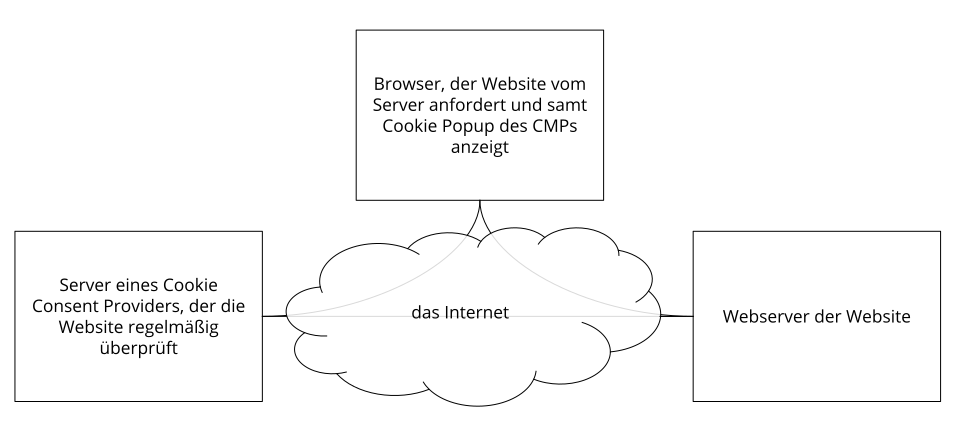
Why do we use a cookie management tool?
Our goal is to offer you the best possible transparency in the area of data protection. We are also legally obliged to do so. We want to inform you as best as possible about all tools and all cookies that can store and process your data. It is also your right to decide for yourself which cookies you accept and which you do not. In order to grant you this right, we first need to know exactly which cookies have landed on our website in the first place. Thanks to a cookie management tool that regularly scans the website for all existing cookies, we know about all cookies and can provide you with information about them in accordance with the GDPR. You can then accept or reject cookies using the consent system.
Which data is processed?
As part of our cookie management tool, you can manage each individual cookie yourself and have complete control over the storage and processing of your data. Your declaration of consent is saved so that we do not have to ask you every time you visit our website and we can also prove your consent if legally required. This is saved either in an opt-in cookie or on a server. The storage period of your cookie consent varies depending on the provider of the cookie management tool. This data (such as pseudonymous user ID, time of consent, details of the cookie categories or tools, browser, device information) is usually saved for up to two years.
duration of data processing
We will inform you about the duration of data processing below, if we have further information. In general, we only process personal data for as long as it is absolutely necessary to provide our services and products. Data stored in cookies is stored for different lengths of time. Some cookies are deleted as soon as you leave the website, others can be stored in your browser for several years. The exact duration of data processing depends on the tool used; in most cases, you should expect a storage period of several years. In the respective data protection declarations of the individual providers, you will usually find precise information about the duration of data processing.
right of objection
You also have the right and the option to withdraw your consent to the use of cookies at any time. This can be done either via our cookie management tool or via other opt-out functions. For example, you can also prevent data collection by cookies by managing, disabling, or deleting cookies in your browser.
Information on specific cookie management tools can be found – if available – in the following sections.
legal basis
If you agree to cookies, these cookies will process and store your personal data. If we receive your consent (Article 6 Paragraph 1 Letter a of GDPR) cookies, this consent is also the legal basis for the use of cookies or the processing of your data. In order to manage the consent to cookies and to enable you to give your consent, a cookie consent management platform software is used. The use of this software enables us to operate the website in an efficient and legally compliant manner, which is a legitimate interest (Article 6 (1) (f) GDPR).
BorlabsCookie Privacy Policy
We use BorlabsCookie on our website, which, among other things, is a tool for storing your cookie consent. The service provider is the German company Borlabs – Benjamin A. Bornschein, Rübenkamp 32, 22305 Hamburg, Germany.
You can find out more about the data processed through the use of BorlabsCookie in the Privacy Policy at [link to Privacy Policy]. https://de.borlabs.io/datenschutz/.
Security & Anti-Spam
|
Security & Anti-Spam Privacy Policy Summary
👥 Affected: Visitors to the website 🤝 Purpose: Cybersecurity 📓 Data processed: Data such as your IP address, name, or technical data such as browser version You can find more details below and in the individual privacy policies. 📅 Storage period: In most cases, the data is stored until it is no longer needed to fulfill the service. ⚖️ Legal basis: Art. 6 para. 1 lit. a GDPR (consent), Art. 6 para. 1 lit. f GDPR (legitimate interests) |
What is security & anti-spam software?
With so-called security and anti-spam software, you and we can protect ourselves from various spam or phishing emails and possible other cyber attacks. Spam is understood to be advertising emails from a mass mailing that you did not request. Such emails are also called data garbage and can also incur costs. Phishing emails, on the other hand, are messages that aim to build trust via fake messages or websites in order to obtain personal data. Anti-spam software usually protects against unwanted spam messages or malicious emails that could, for example, introduce viruses into our system. We also use general firewall and security systems that protect our computers from unwanted network attacks.
Why do we use security & anti-spam software?
We place particular emphasis on security on our website. After all, it's not just about our security, but above all about yours. Unfortunately, cyber threats are now part of everyday life in the world of IT and the Internet. Hackers often try to steal personal data from an IT system using a cyber attack. And that's why a good defense system is absolutely essential. A security system monitors all incoming and outgoing connections to our network or computer. To achieve even greater security against cyber attacks, we use other external security services in addition to the standardized security systems on our computer. This makes it easier to prevent unauthorized traffic of data and protects us against cybercrime.
What data is processed by security and anti-spam software?
Exactly which data is collected and stored depends on the respective service. However, we always endeavor to only use programs that collect data very sparingly or only store data that is necessary to fulfill the service offered. In principle, the service can store data such as name, address, IP address, email address and technical data such as browser type or browser version. Any performance and log data can also be collected in order to detect possible incoming threats in good time. This data is processed as part of the services and in compliance with applicable laws. For US providers, this also includes the GDPR (via the standard contractual clauses). In some cases, these security services also work with third parties who can store and/or process data under instruction and in accordance with data protection guidelines and other security measures. Data is usually stored via cookies.
duration of data processing
We will inform you below about the duration of data processing if we have further information. For example, security programs store data until you or we revoke the data storage. In general, personal data is only stored for as long as it is absolutely necessary to provide the services. In many cases, unfortunately, we do not have precise information from the providers about the length of storage.
right of objection
You also have the right and the option to withdraw your consent to the use of cookies or third-party security software at any time. This can be done either via our cookie management tool or via other opt-out functions. For example, you can also prevent data collection by cookies by managing, disabling, or deleting cookies in your browser.
Since such security services may also use cookies, we recommend that you read our general privacy policy on cookies. To find out exactly what data is stored and processed about you, you should read the privacy policies of the respective tools.
legal basis
We primarily use security services based on our legitimate interests (Art. 6 para. 1 lit. f GDPR) in a good security system against various cyberattacks.
Certain data processing activities, in particular the use of cookies and security features, require your consent. If you have consented to the processing and storage of your data by integrated security services, this consent serves as the legal basis for data processing (Art. 6 para. 1 lit. a GDPR). Most of the services we use place cookies in your browser to store data. Therefore, we recommend that you carefully read our privacy policy regarding cookies and review the privacy statement or cookie policy of the respective service provider.
Information on specific tools – if available – can be found in the following sections.
cloud services
|
Cloud Services Privacy Policy Summary
👥 Affected parties: We as website operators and you as website visitors 🤝 Purpose: Security and data storage 📓 Data processed: Data such as your IP address, name, or technical data such as browser version You can find more details below and in the individual data protection texts or in the privacy policies of the providers. 📅 Storage period: In most cases, the data is stored until it is no longer needed to fulfill the service. ⚖️ Legal basis: Art. 6 para. 1 lit. a GDPR (consent), Art. 6 para. 1 lit. f GDPR (legitimate interests) |
What are cloud services?
Cloud services provide us as website operators with storage space and computing power over the Internet. Data can be transferred to an external system, processed and stored over the Internet. The relevant cloud provider manages this data. Depending on requirements, an individual or a company can choose the storage space size or computing power. Cloud storage is accessed via an API or storage protocols. API stands for Application Programming Interface and is a programming interface that connects software and hardware components.
Why do we use cloud services?
We use cloud services for several reasons. A cloud service allows us to store our data securely. Furthermore, we can access the data from various locations and devices, giving us greater flexibility and streamlining our workflows. Cloud storage also saves us money because we don't need to build and manage our own data storage and security infrastructure. Storing our data centrally in the cloud also allows us to expand our applications and manage our information much more effectively.
As website operators and companies, we primarily use cloud services for our own purposes. For example, we use these services to manage our calendar and to store documents and other important information in the cloud. However, your personal data may also be stored in this process. This is the case, for instance, if you provide us with your contact information (such as your name and email address) and we store our customer data with a cloud provider. Consequently, data that we process from you may also be stored and processed on external servers. When we offer certain forms or content from cloud services on our website, cookies may also be set for web analytics and advertising purposes. Furthermore, these cookies remember your settings (such as your preferred language) so that you find your familiar web environment the next time you visit our website.
What data is processed by cloud services?
Much of the data we store in the cloud is not personally identifiable, but some data is considered personal data according to the definition of the GDPR. This is often customer data such as name, address, IP address or telephone number, or technical device information. Videos, images and audio files can also be stored in the cloud. How exactly the data is collected and stored depends on the respective service. We try to only use services that handle the data in a very trustworthy and professional manner. In principle, the services, such as Amazon Drive, have access to the stored files in order to be able to offer their own service accordingly. However, the services require permissions such as the right to copy files for security reasons. This data is processed and managed as part of the services and in compliance with applicable laws. For US providers, this also includes the GDPR (via the standard contractual clauses). In some cases, these cloud services also work with third parties who can process data under instruction and in accordance with the data protection guidelines and other security measures. We would like to emphasize again at this point that all well-known cloud services (such as Amazon Drive, Google Drive or Microsoft Onedrive) obtain the right to have access to stored content in order to be able to offer and optimize their own service accordingly.
duration of data processing
We will inform you below about the duration of data processing if we have further information. In general, cloud services store data until you or we revoke the data storage consent or delete the data again. In general, personal data is only stored for as long as it is absolutely necessary to provide the services. However, permanently deleting data from the cloud can take several months. This is the case because the data is usually not stored on just one server, but is divided up across different servers.
right of objection
You also have the right and the option to withdraw your consent to data storage in a cloud at any time. If cookies are used, you also have the right to withdraw your consent. This can be done either via our cookie management tool or via other opt-out functions. For example, you can also prevent data collection by cookies by managing, disabling, or deleting cookies in your browser. We also recommend that you read our general privacy policy about cookies. To find out exactly which of your data is stored and processed, you should read the privacy policies of the respective cloud providers.
legal basis
We primarily use cloud services based on our legitimate interests (Art. 6 para. 1 lit. f GDPR) in a good security and storage system.
Certain processing activities, in particular the use of cookies and storage functions, require your consent. If you have consented to your data being processed and stored by cloud services, this consent serves as the legal basis for data processing (Art. 6 para. 1 lit. a GDPR). Most of the services we use place cookies in your browser to store data. Therefore, we recommend that you carefully read our privacy policy regarding cookies and review the privacy statement or cookie policy of the respective service provider.
Information on specific tools – if available – can be found in the following sections.
Google Cloud Privacy Policy
We use Google Cloud, an online storage service for files, photos, and videos, for our website. The service provider is the American company Google Inc. For the European region, Google Ireland Limited (Gordon House, Barrow Street, Dublin 4, Ireland) is responsible for all Google services.
Google processes your data, among other places, in the USA. Google is an active participant in the EU-US Data Privacy Framework, which regulates the correct and secure transfer of personal data of EU citizens to the USA. You can find more information about this at [link to Google's privacy policy]. https://commission.europa.eu/document/fa09cbad-dd7d-4684-ae60-be03fcb0fddf_en.
Furthermore, Google uses so-called Standard Contractual Clauses (Article 46, paragraphs 2 and 3 of the GDPR). Standard Contractual Clauses (SCCs) are template agreements provided by the European Commission and are designed to ensure that your data complies with European data protection standards even when it is transferred to and stored in third countries (such as the USA). Through the EU-US Data Privacy Framework and the Standard Contractual Clauses, Google commits to maintaining European data protection standards when processing your relevant data, even if the data is stored, processed, and managed in the USA. These clauses are based on an implementing decision of the European Commission. You can find the decision and the corresponding Standard Contractual Clauses here, among other places: https://eur-lex.europa.eu/eli/dec_impl/2021/914/oj?locale=de
Google has a contract for order processing in accordance with Art. 28 GDPR, which serves as the data protection basis for our customer relationship with Google. The content of this refers to the EU standard contractual clauses. You can find the order processing conditions here: https://business.safety.google/intl/de/adsprocessorterms/
You can find out more about the data processed through the use of Google Cloud in the Privacy Policy on https://policies.google.com/privacy?hl=de.
Audio & Video Introduction
|
Audio & Video Privacy Policy Summary
👥 Affected: Visitors to the website 🤝 Purpose: To optimize our service performance 📓 Data processed: Data such as contact details, user behavior data, information about your device and your IP address may be stored. You can find more details below in the corresponding privacy policy texts. 📅 Storage period: Data is generally stored as long as it is needed for the service purpose. ⚖️ Legal basis: Art. 6 para. 1 lit. a GDPR (consent), Art. 6 para. 1 lit. f GDPR (legitimate interests) |
What are audio and video elements?
We have integrated audio and video elements into our website so that you can watch videos or listen to music/podcasts directly through our site. The content is provided by service providers. Therefore, all content is retrieved from the respective servers of these providers.
These are embedded features from platforms such as YouTube, Vimeo, or Spotify. Using these platforms is generally free, but they may also offer paid content. These embedded features allow you to listen to or watch the respective content directly on our website.
When you use audio or video elements on our website, your personal data may also be transmitted to, processed and stored by the service providers.
Why do we use audio & video elements on our website?
Of course, we want to offer you the best on our website. And we are aware that content is no longer just conveyed in text and static images. Instead of simply giving you a link to a video, we offer you audio and video formats directly on our website that are entertaining or informative and, ideally, even both. This expands our service and makes it easier for you to access interesting content. This means that in addition to our texts and images, we also offer video and/or audio content.
What data is stored by audio & video elements?
When you visit a page on our website that has an embedded video, for example, your server connects to the service provider's server. In the process, your data is also transferred to the third-party provider and stored there. Some data is collected and stored regardless of whether you have an account with the third-party provider or not. This usually includes your IP address, browser type, operating system, and other general information about your device. Furthermore, most providers also collect information about your web activity. This includes session duration, bounce rate, which button you clicked on, or which website you used to use the service. All of this information is usually stored via cookies or pixel tags (also called web beacons). Pseudonymized data is usually stored in cookies in your browser. You can always find out exactly which data is stored and processed in the privacy policy of the respective provider.
duration of data processing
You can find out exactly how long the data is stored on the third-party providers' servers either further down in the data protection text of the respective tool or in the provider's data protection declaration. In principle, personal data is only processed for as long as it is absolutely necessary to provide our services or products. This generally also applies to third-party providers. You can usually assume that certain data will be stored on the third-party providers' servers for several years. Data can be stored for different lengths of time, especially in cookies. Some cookies are deleted as soon as you leave the website, others can be stored in your browser for several years.
right of objection
You also have the right and the option to withdraw your consent to the use of cookies or third-party providers at any time. This can be done either via our cookie management tool or via other opt-out functions. For example, you can also prevent data collection by cookies by managing, disabling, or deleting cookies in your browser. The lawfulness of the processing up to the point of withdrawal remains unaffected.
Since the integrated audio and video functions on our site usually also use cookies, you should also read our general privacy policy about cookies. The privacy policies of the respective third-party providers provide more detailed information about how they handle and store your data.
legal basis
If you have consented that your data can be processed and stored through embedded audio and video elements, this consent is considered the legal basis for data processing (Art. 6 para. 1 lit. a GDPR)In principle, your data will also be processed on the basis of our legitimate interest (Art. 6 para. 1 lit. f GDPR) to ensure fast and good communication with you or other customers and business partners. However, we only use the integrated audio and video elements if you have given your consent.
YouTube privacy policy
|
YouTube Privacy Policy Summary
👥 Affected: Visitors to the website 🤝 Purpose: To optimize our service performance 📓 Data processed: Data such as contact details, user behavior data, information about your device and your IP address may be stored. You can find more details below in this privacy policy. 📅 Storage period: Data is generally stored as long as it is needed for the service purpose. ⚖️ Legal basis: Art. 6 para. 1 lit. a GDPR (consent), Art. 6 para. 1 lit. f GDPR (legitimate interests) |
What is YouTube?
We have embedded YouTube videos on our website. This allows us to present interesting videos directly on our site. YouTube is a video portal that has been a subsidiary of Google since 2006. The video portal is operated by YouTube, LLC, 901 Cherry Ave., San Bruno, CA 94066, USA. When you visit a page on our website that has an embedded YouTube video, your browser automatically connects to the servers of YouTube or Google. Depending on your settings, various data is transmitted during this process. Google Ireland Limited (Gordon House, Barrow Street, Dublin 4, Ireland) is responsible for all data processing within the European Economic Area.
Below we would like to explain in more detail which data is processed, why we have embedded YouTube videos and how you can manage or delete your data.
On YouTube, users can watch, rate, comment on, and upload videos for free. Over the past few years, YouTube has become one of the most important social media channels worldwide. To enable us to display videos on our website, YouTube provides a code snippet that we have embedded on our site.
Why do we use YouTube videos on our website?
YouTube is the video platform with the most visitors and the best content. We strive to offer you the best possible user experience on our website. And of course, interesting videos are a must. With the help of our embedded videos, we provide you with additional helpful content in addition to our texts and images. In addition, our website is easier to find on the Google search engine thanks to the embedded videos. Even if we place advertisements via Google Ads, Google can - thanks to the data collected - only show these advertisements to people who are interested in our offers.
What data does YouTube store?
As soon as you visit one of our pages that has an embedded YouTube video, YouTube sets at least one cookie that stores your IP address and our URL. If you are logged into your YouTube account, YouTube can usually associate your interactions on our website with your profile using cookies. This includes data such as session duration, bounce rate, approximate location, and technical information like browser type, screen resolution, and your internet service provider. Other data may include contact information, any ratings, sharing content via social media, or adding videos to your favorites on YouTube.
If you're not signed in to a Google or YouTube account, Google stores data with a unique identifier linked to your device, browser, or app. This allows, for example, your preferred language setting to be retained. However, much interaction data cannot be stored because fewer cookies are set.
The following list shows cookies that were set in a browser test. We show cookies that were set both when no user was logged into a YouTube account and when a user was logged in. This list is not exhaustive, as user data always depends on interactions on YouTube.
Name: YSC
Value: b9-CV6ojI5Y112059781-1
Purpose of use: This cookie registers a unique ID to store statistics of the video watched.
Expiration date: after the end of the session
Name: PREF
Value: f1=50000000
Purpose of use: This cookie also registers your unique ID. Google uses PREF to get statistics on how you use YouTube videos on our website.
Expiration date: after 8 months
Name: GPS
Value: 1
Purpose of use: This cookie registers your unique ID on mobile devices to track GPS location.
Expiration date: after 30 minutes
Name: VISITOR_INFO1_LIVE
Value: 95Chz8bagyU
Purpose of use: This cookie tries to estimate the bandwidth of the user on our websites (with embedded YouTube video).
Expiration date: after 8 months
Other cookies that are set when you are logged in with your YouTube account:
Name: APISID
Value: zILLlvClZSkqGsSwI/AU1aZI6HY7112059781-
Purpose of use: This cookie is used to create a profile of your interests. The data is used for personalized advertisements.
Expiration date: after 2 years
Name: CONSENT
Value: YES+AT.de+20150628-20-0
Purpose of use: The cookie stores the status of a user's consent to use various Google services. CONSENT is also used for security purposes to verify users and protect user data from unauthorized attacks.
Expiration date: after 19 years
Name: HSID
Value: AcRwpgUik9Dveht0I
Purpose of use: This cookie is used to create a profile of your interests. This data helps to display personalized advertising.
Expiration date: after 2 years
Name: LOGIN_INFO
Value: AFmmF2swRQIhALl6aL…
Purpose of use: This cookie stores information about your login data.
Expiration date: after 2 years
Name: SAPISID
Value: 7oaPxoG-pZsJuuF5/AnUdDUIsJ9iJz2vdM
Purpose of use: This cookie works by uniquely identifying your browser and device. It is used to build a profile of your interests.
Expiration date: after 2 years
Name: SID
Value: oQfNKjAsI112059781-
Purpose of use: This cookie stores your Google Account ID and your last login time in a digitally signed and encrypted form.
Expiration date: after 2 years
Name: SIDCC
Value: AN0-TYuqub2JOcDTyL
Purpose of use: This cookie stores information about how you use the website and what advertisements you may have seen before visiting our site.
Expiration date: after 3 months
How long and where is the data stored?
The data that YouTube receives and processes from you is stored on Google servers. Most of these servers are located in America. https://datacenters.google/ See exactly where Google's data centers are located. Your data is distributed across the servers. This makes the data faster to access and better protected against manipulation.
Google stores the collected data for varying lengths of time. Some data can be deleted at any time, some is automatically deleted after a limited period, and still other data is stored by Google for longer periods. Some data (such as items from "My Activity," photos or documents, and products) stored in your Google Account remains stored until you delete it. Even if you are not signed in to a Google Account, you can delete some data associated with your device, browser, or app.
How can I delete my data or prevent data storage?
You can manually delete data from your Google account. However, with the automatic deletion feature for location and activity data introduced in 2019, information is stored for either 3 or 18 months, depending on your choice, and then deleted.
Whether or not you have a Google account, you can configure your browser to delete or disable cookies from Google. The process varies depending on the browser you use. Under the "Cookies" section, you will find links to instructions for the most popular browsers.
If you do not want cookies at all, you can set your browser to always inform you when a cookie is about to be placed. This way you can decide for each individual cookie whether you want to allow it or not.
legal basis
If you have consented that your data can be processed and stored through embedded YouTube elements, this consent is considered the legal basis for data processing (Art. 6 para. 1 lit. a GDPR)In principle, your data will also be processed on the basis of our legitimate interest (Art. 6 para. 1 lit. f GDPR) Your data is stored and processed to ensure fast and effective communication with you, other customers, and business partners. However, we only use the embedded YouTube elements if you have given your consent. YouTube also uses cookies in your browser to store data. Therefore, we recommend that you carefully read our privacy policy regarding cookies and review the privacy statement or cookie policy of the respective service provider.
YouTube processes your data, among other places, in the USA. YouTube, or rather Google, is an active participant in the EU-US Data Privacy Framework, which regulates the correct and secure transfer of personal data of EU citizens to the USA. You can find more information about this at [link to relevant page]. https://commission.europa.eu/document/fa09cbad-dd7d-4684-ae60-be03fcb0fddf_en.
Furthermore, Google uses so-called Standard Contractual Clauses (Article 46, paragraphs 2 and 3 of the GDPR). Standard Contractual Clauses (SCCs) are template agreements provided by the European Commission and are designed to ensure that your data complies with European data protection standards even when it is transferred to and stored in third countries (such as the USA). Through the EU-US Data Privacy Framework and the Standard Contractual Clauses, Google commits to maintaining European data protection standards when processing your relevant data, even if the data is stored, processed, and managed in the USA. These clauses are based on an implementing decision of the European Commission. You can find the decision and the corresponding Standard Contractual Clauses here, among other places: https://eur-lex.europa.eu/eli/dec_impl/2021/914/oj?locale=de
The Google Ads Data Processing Terms, which refer to the standard contractual clauses, can be found at https://business.safety.google/intl/de/adsprocessorterms/.
Since YouTube is a subsidiary of Google, they share a privacy policy. If you would like to learn more about how your data is handled, we recommend reading the privacy policy at [link to privacy policy]. https://policies.google.com/privacy?hl=de.
YouTube Subscribe Button Privacy Policy
We have integrated the YouTube subscribe button into our website. You can usually recognize the button by the classic YouTube logo. The logo shows the words "Subscribe" or "YouTube" in white lettering against a red background, with the white play symbol to the left. However, the button may also be displayed in a different design.
Our YouTube channel regularly offers you funny, interesting, or exciting videos. With the built-in "Subscribe" button, you can subscribe to our channel directly from our website without having to visit the YouTube website separately. We want to make accessing our extensive content as easy as possible for you. Please note that YouTube may store and process your data as a result.
If you see a built-in subscribe button on our site, YouTube – according to Google – sets at least one cookie. This cookie stores your IP address and our URL. YouTube can also learn information about your browser, your approximate location, and your preferred language. In our test, the following four cookies were set without us being logged into YouTube:
Name: YSC
Value: b9-CV6ojI5112059781Y
Purpose of use: This cookie registers a unique ID to store statistics of the video watched.
Expiration date: after the end of the session
Name: PREF
Value: f1=50000000
Purpose of use: This cookie also registers your unique ID. Google uses PREF to get statistics on how you use YouTube videos on our website.
Expiration date: after 8 months
Name: GPS
Value: 1
Purpose of use: This cookie registers your unique ID on mobile devices to track GPS location.
Expiration date: after 30 minutes
Name: VISITOR_INFO1_LIVE
Value: 11205978195Chz8bagyU
Purpose of use: This cookie tries to estimate the bandwidth of the user on our websites (with embedded YouTube video).
Expiration date: after 8 months
Note: These cookies were set after a test and cannot claim to be exhaustive.
If you are logged into your YouTube account, YouTube can use cookies to store many of your actions/interactions on our website and associate them with your YouTube account. This allows YouTube to obtain information such as how long you browse our site, which browser type you use, your preferred screen resolution, and other actions you perform.
YouTube uses this data firstly to improve its own services and offers, and secondly to provide analyses and statistics for advertisers (who use Google Ads).

Products & Industries
News
- 55 years of Wick Machinery: A celebration of people, technology and community spirit September 8, 2026
- Wick-Machinery is now a registered trademark. July 1, 2026
- Thank you for visiting INTERPACK 2026 June 15, 2026
- Wick Machinery – Your reliable partner in uncertain times May 15, 2026

